Range Hood Motor Quality Control: The Ultimate OEM Audit Checklist
For OEM appliance manufacturers, the reliability of a final product is only as strong as its core components. Implementing rigorous range hood motor quality control is the single most effective strategy for preventing post-sale warranty claims, protecting brand reputation, and ensuring compliance with international safety standards (CE Mark).
However, not all factory testing protocols are equal. While generic trading companies may provide a visual inspection before shipment, true industrial manufacturers employ exhaustive thermodynamic, electrical, and acoustic testing to guarantee batch consistency across tens of thousands of units.
This guide provides QA Directors and Procurement Managers with a comprehensive, technical OEM blower QA testing checklist to evaluate a motor manufacturer’s quality control infrastructure before committing to a bulk B2B supply agreement.
Why OEM Buyers Must Audit Motor Manufacturing Processes
Sourcing centrifugal blowers without auditing the factory’s QA procedures introduces catastrophic risks to your assembly line. A poorly wound stator can result in electrical shorts in high-humidity kitchens. An imbalanced impeller will transfer severe kinetic vibration to the metal hood chassis, resulting in unacceptable acoustic resonance (rattling).
An effective factory audit transitions procurement from a gamble into a calculated engineering decision. By demanding proof of specific testing methodologies, OEM buyers can confidently forecast defect rates and secure a stable supply chain.
The 5-Stage OEM Blower QA Audit Checklist
When auditing a potential motor supplier, require documented proof that the following five quality control stages are integrated into their daily assembly line operations.
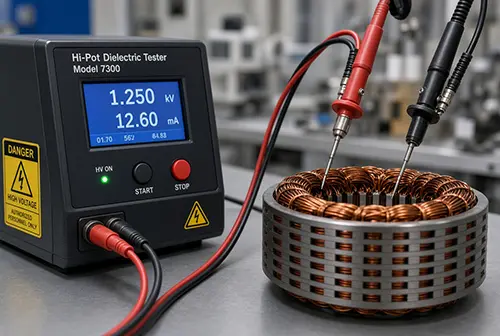
1. Dielectric Withstand Testing (Hi-Pot) for Electrical Safety
Before final assembly, the motor’s copper windings must undergo Dielectric Withstand Testing (commonly known as a Hi-Pot test). The factory applies a high voltage to the windings to ensure the insulation is not compromised.
- Audit Check: Does the factory test 100% of the stators, or do they only perform random batch sampling? (Electro NASA performs 100% Hi-Pot testing on all K30 and Turbo series motors to guarantee zero electrical leakage).
2. Precision Dynamic Balancing for Acoustic Control
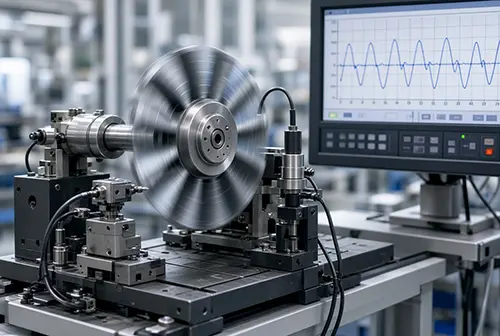
Static balancing is insufficient for high-speed centrifugal motors, which is why our Turbo Series high-efficiency OEM blowers undergo precision dynamic balancing on micro-calibrated machinery to detect and correct eccentric weight distribution across multiple axes.
- Audit Check: Ask for the decibel (dB) variance and vibration tolerance data for the impellers. If the factory cannot provide aerodynamic acoustic mapping, they are not performing true dynamic balancing, which will result in noisy appliances.
3. Thermal Load Simulation (Class 180/200 Validation)
Our Class 180 heavy-duty exhaust fan motors must survive continuous operation over high-BTU gas ranges. The factory must simulate these extreme thermal loads to validate the effectiveness of their Class 180 or Class 200 insulation varnishes.
- Audit Check: Verify that the auto-resetting thermal protectors successfully interrupt the circuit during simulated duct blockages without causing permanent damage to the copper coils.
4. Needle-Flame and Fire Retardant Verification
If your appliance utilizes plastic motor volutes (such as the compact K30 3111/3112 models), fire safety is paramount. The plastics must conform to the international IEC 60695-11-5 needle-flame test standard.
- Audit Check: Request documentation proving the polymers pass the needle-flame test. This ensures that in the event of an electrical fault, the plastic will not propagate combustion inside the enclosed cabinetry.
5. Galvanic Corrosion and Environmental Stress Testing
Kitchen exhausts pull heavy moisture, grease, and salt (in coastal environments) through the motor housing.
- Audit Check: For metal housings, verify that the factory utilizes weld-less and rivet-less galvanized steel assemblies. Request salt spray test results to confirm that the interlocking chassis resists galvanic corrosion significantly better than cheap spot-welded alternatives.
Red Flags: How to Spot a Failing QA Department
During your factory audit (whether physical or remote), watch for these critical red flags:
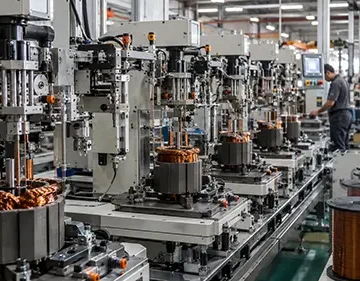
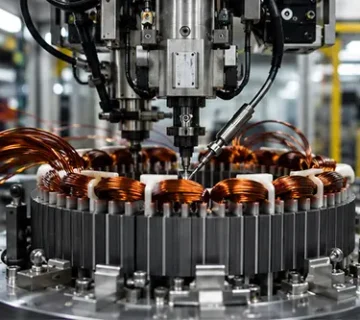
- Manual Copper Winding: Automated winding machines guarantee uniform coil tension. Manual winding introduces severe human error, leading to inconsistent electrical resistance and premature thermal burnout.
- No Acoustic Chamber: A factory cannot claim to produce “super-silent” blowers (like the Turbo 2113) if they do not possess an isolated acoustic chamber to measure decibel outputs accurately.
- Lack of Traceability: If a motor fails QA, the factory must be able to trace it back to the specific raw material batch. Without traceability, batch consistency is impossible.
The Electro NASA Approach: ISO 9001:2015 Batch Consistency
As a primary industrial manufacturer established in 1999, Nam Avarane Sanaye Arvin Co. (Electro NASA) does not rely on sub-contractors for quality control.
By operating under a strict ISO 9001:2015 Quality Management System, Electro NASA ensures that every centrifugal blower undergoes the 5-stage audit described above.
Best Practices for Conducting a Remote Factory Audit
If international travel is restrictive, QA Directors can still conduct rigorous remote audits:
- Live Video Walkthroughs: Request a live, unedited video call touring the dynamic balancing stations and the Hi-Pot testing area.
- Request Raw Test Data: Ask for the raw data logs from the acoustic chamber for a recently produced batch, rather than a polished marketing summary.
- Validate Certificates: Do not just accept a PDF. Verify the factory’s ISO 9001:2015 and CE Mark certificates directly with the issuing regulatory bodies.
Frequently Asked Questions
How does dynamic balancing differ from static balancing in QA testing? Static balancing only checks for weight distribution while the impeller is stationary, which is inadequate for high RPM operation. Precision dynamic balancing spins the impeller at operational speeds and uses laser/acoustic sensors to detect and correct multi-axis vibrations, ensuring the motor will not rattle the appliance chassis.
What is the primary cause of galvanic corrosion in motor housings? Galvanic corrosion typically initiates at spot-welds, where the extreme heat destroys the protective zinc coating on galvanized steel. Electro NASA passes corrosion QA testing by utilizing an interlocking, weld-less and rivet-less assembly process that preserves the entire anti-corrosive layer.
Can OEM buyers customize the QA testing parameters? Yes. Primary manufacturers will work with your R&D engineers to establish specific Pass/Fail tolerances based on your appliance’s unique requirements — this is exactly the kind of detail to confirm during a bulk motor factory audit, such as establishing a strict maximum decibel limit for premium “silent” hood product lines.
Why is 100% Hi-Pot testing necessary? Random batch sampling for electrical safety is a massive liability. A single stator with compromised insulation can cause a dangerous short circuit in a high-humidity kitchen environment. 100% Hi-Pot testing ensures absolute compliance and consumer safety for every unit shipped.
Partner with a manufacturer that prioritizes engineering integrity. Request an OEM Quotation & Production Lead Time to secure defect-free, ISO-certified bulk motor supplies.
Require customized QA testing tolerances for your premium appliances? Consult with Electro NASA Technical Sales Engineers to discuss tailored inspection protocols.