Factory Direct Range Hood Motors: Benefits and Risks for Buyers
For OEM appliance manufacturers, securing a reliable supply of centrifugal blowers is a strategic imperative. The decision of where to source these critical components—whether to buy factory direct range hood motors or utilize third-party trading companies—profoundly impacts product quality, warranty claim rates, and overall profit margins.
Historically, many procurement managers utilized brokers to navigate international sourcing. However, as the engineering demands of modern range hoods increase (requiring advanced PCB mapping and strict acoustic tolerances), the hidden risks of trading companies have become apparent.
This guide evaluates the benefits and risks of both sourcing models, explaining why leading appliance brands are transitioning exclusively to direct factory partnerships to ensure supply chain transparency and batch consistency. If you’d rather skip straight to specs and pricing, you can browse our wholesale kitchen extractor fans directly.
The Shift Toward Direct OEM Blower Factory Sourcing
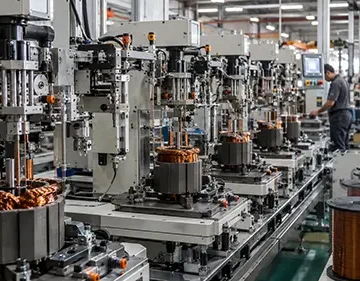
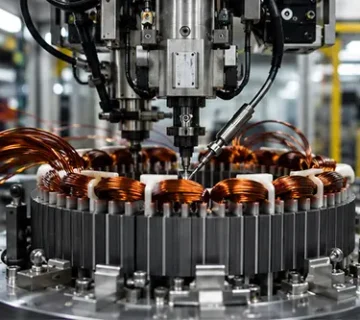
A primary industrial manufacturer, like Nam Avarane Sanaye Arvin Co. (Electro NASA), owns the entire production process—from injection molding and copper winding to dynamic balancing and final assembly. Conversely, a trading company (or broker) owns no manufacturing equipment; they aggregate orders and sub-contract the production to the lowest bidder.
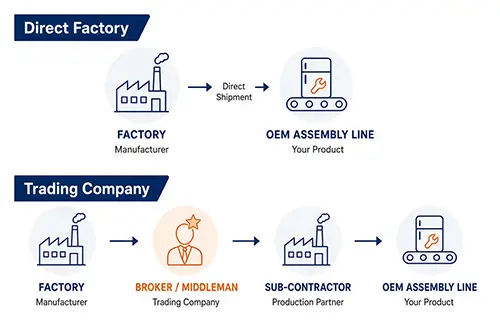
For OEM buyers, the shift toward direct sourcing is driven by the need to eliminate the variables introduced by middlemen. Direct sourcing secures a transparent supply chain where engineering requirements are communicated directly to the factory floor, rather than filtered through a sales intermediary.
3 Major Risks of Sourcing from Third-Party Brokers
While trading companies often present attractive initial pricing and low Minimum Order Quantities (MOQs), procurement managers must be aware of the long-term engineering and logistical risks.
1. Inconsistent Batch Quality and “Bait and Switch” Tactics
The most significant risk of broker sourcing is batch inconsistency. Because brokers utilize a rotating network of sub-contractors, the motors in your first container may differ entirely from those in the third container. A broker might ship a prototype featuring Class 180 insulation, but fulfill the bulk order with inferior Class 130 windings to maximize their margin. This “bait and switch” tactic leads directly to thermal burnout and massive warranty liabilities for the OEM brand.
2. Lack of Direct Engineering Support and PCB Integration
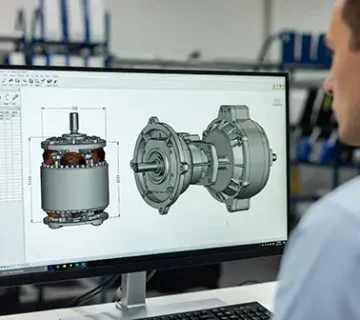
Integrating a modern AC centrifugal motor with capacitive touch panels requires precise electrical coordination. Brokers lack in-house R&D departments. If your assembly line requires a custom 1-to-8 speed mapping for the appliance PCB, a trading company cannot provide the necessary technical support, CAD files, or aerodynamic performance curves required for engineering validation.
3. Voided or Unenforceable Warranties
When a shipment of defective motors arrives from a broker, enforcing a warranty is notoriously difficult. The broker will often blame their sub-contractor, who in turn blames the broker, leaving the OEM buyer absorbing the financial loss.
The Strategic Advantages of Buying Direct from the Manufacturer
Partnering directly with a factory eliminates the communication barriers and quality fluctuations inherent in the broker model.
Uncompromising Quality Control (ISO 9001:2015)
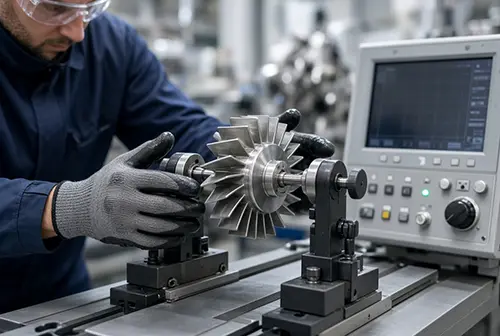
Primary manufacturers operate under strict, audited protocols.Electro NASA’s adherence to ISO 9001:2015 standards ensures that every unit undergoes identical testing, including dielectric withstand (Hi-Pot) tests and precision dynamic balancing. This absolute control over the assembly line guarantees that unit number 10,000 performs exactly like the approved prototype.
Guaranteed 24-Month Direct Factory Warranty
Because the manufacturer controls the sourcing of raw materials (such as weld-less galvanized steel and needle-flame standard plastics) — the same materials used across our K30 series heavy-duty motors they can confidently stand behind their products. Electro NASA provides a 24-month direct factory warranty, offering OEM buyers financial security and recourse that trading companies simply cannot match.
Supply Chain Transparency and Stable Lead Times
Direct factory sourcing provides a transparent view into production capacity. Established in 1999, Electro NASA consistently exports over 30% of its production capacity. This established logistical infrastructure allows procurement managers to accurately forecast their total landed cost and rely on stable, predictable lead times.
Factory Direct vs. Broker Sourcing: A B2B Comparison Matrix
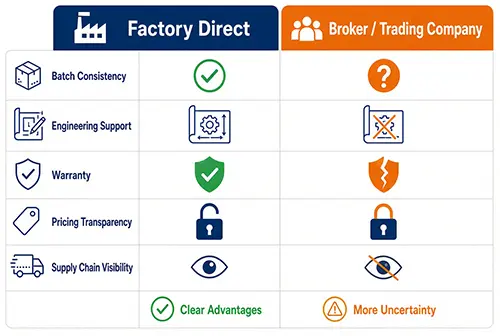
Use this matrix to evaluate the operational trade-offs between the two sourcing models.
| Evaluation Metric | Primary Industrial Manufacturer (Electro NASA) | Third-Party Trading Company (Broker) | Impact on OEM Buyer |
|---|---|---|---|
| Batch Consistency | Excellent (ISO 9001:2015 controlled) | Highly Variable | Reduces assembly line defects and recalls. |
| Engineering Support | Direct R&D access, CAD files, Custom PCB mapping | None / Relayed through sales reps | Accelerates product development and integration. |
| Warranty Reliability | 24-Month direct factory warranty | Often unenforceable | Protects profit margins from post-sale claims. |
| Pricing Structure | Transparent base price (FOB/CIF) | Hidden margins and markups | Lowers the total landed cost per unit. |
| Supply Chain Visibility | Full transparency into factory capacity | Opaque / Sub-contractor reliance | Ensures predictable production lead times. |
How to Verify You Are Buying from a Primary Industrial Manufacturer
Before signing a supply agreement, OEM buyers must verify that they are dealing with a factory, not a broker.
- Request a Factory Audit: Reputable manufacturers welcome video tours or third-party audits of their injection molding and copper winding lines.
- Verify ISO Certifications: Request the official ISO 9001:2015 certificate and verify that the company name matches the manufacturing facility address, not a downtown office suite.
- Demand Engineering Documentation: Ask for specific aerodynamic curves (Static Pressure vs. CFM) for their motors. Brokers rarely possess this level of technical documentation.
Frequently Asked Questions
Is there ever a scenario where buying from a broker makes sense? Brokers can be useful for small, one-off purchases or extremely low-volume orders where the buyer cannot meet a direct factory’s Minimum Order Quantity (MOQ). However, for continuous OEM production lines, the risks of batch inconsistency far outweigh the convenience of low MOQs — especially once you calculate the total landed cost of replacing a defective batch.
How does a direct factory warranty work for international shipments? A direct factory warranty (like Electro NASA’s 24-month guarantee) typically covers the replacement cost or provides credit for defective units in subsequent shipments. Because the factory controls the production, they can perform root-cause analysis on failed units and correct the manufacturing process, a service brokers cannot provide.
Can a primary manufacturer help us customize our appliance? Yes. Buying direct allows your R&D team to collaborate with the factory’s engineers. For example, if your appliance requires a highly compact footprint, a primary manufacturer can customize the motor with a forward-curved impeller and a capacitor-less architecture to save space on your internal PCB.
Call to Action
Eliminate supply chain uncertainty with direct factory sourcing. **Request an OEM Quotation & Production Lead Time** today to secure transparent pricing and consistent quality.
Tired of inconsistent motor performance from third-party suppliers? Consult with Electro NASA Technical Sales Engineers to learn how our ISO 9001:2015 audited processes guarantee batch consistency.