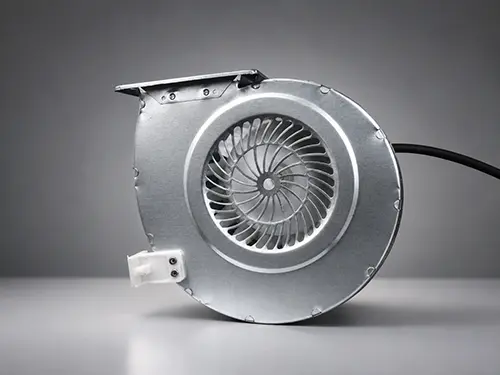
Quiet Range Hood Motor Technology: Engineering Low-Noise Ventilation
Kitchen appliance manufacturers and technical procurement managers face a continuous engineering challenge: maximizing the volumetric airflow of ventilation systems while strictly minimizing acoustic emissions. Sourcing a truly quiet range hood motor requires looking beyond basic specifications and evaluating the mechanical and aerodynamic precision of the component. For OEM manufacturers, understanding the physics of noise reduction is critical to selecting the right electric motor for premium consumer and industrial applications.
As an established manufacturer of industrial and household ventilation motors since the late 1990s, Electro NASA engineers low-noise solutions—such as the Turbo Series—specifically designed to meet these stringent requirements. This technical guide explores the primary physical, mechanical, and electromagnetic factors that dictate acoustic performance in kitchen hood motors.
The Engineering Physics Behind Kitchen Ventilation Noise
Before addressing component-level design, it is necessary to establish the metrics used to quantify acoustic emissions in ventilation systems. A quiet range hood motor is the result of minimizing specific types of acoustic energy across the entire operational spectrum.
Defining Sound Power vs. Sound Pressure Level (SPL)
When analyzing acoustic data, engineers must differentiate between Sound Power ($L_w$) and Sound Pressure Level ($L_p$). Sound power represents the total acoustic energy generated by the motor itself, independent of its environment, measured in watts. Conversely, Sound Pressure Level measures the acoustic pressure variations at a specific distance from the source, measured in pascals.
When evaluating a quiet range hood motor, OEM buyers must ensure that manufacturer data specifies which metric is being reported, as sound pressure levels will vary significantly based on the acoustic dampening of the hood enclosure and the dimensions of the testing laboratory environment.
The testing methodology described in ISO 3744 for sound power measurement provides internationally recognized procedures for evaluating airborne noise generated by industrial equipment.
Identifying the Three Primary Noise Sources in Ventilation
Acoustic output in electric motors stems from three distinct physical phenomena. Effective noise reduction requires isolating and mitigating each source independently:
| Noise Classification | Physical Origin | Primary Mitigation Strategy |
| Aerodynamic | Air turbulence and blade pass frequency | Aerodynamically optimized impeller blade geometry |
| Mechanical | Bearing friction, structural resonance, and mass imbalance | Precision dynamic balancing and high-grade bearings |
| Electromagnetic | Magnetostriction from alternating current (AC) fields | Tightly bonded and reinforced stator laminations |
How Decibels (dB) and Sones Relate to Human Perception
Acoustic emissions are typically measured in decibels (dB), a logarithmic unit indicating sound intensity. However, the kitchen appliance industry frequently utilizes Sones to quantify subjective loudness. Unlike the decibel scale, Sones are linear; a range hood operating at two Sones is perceived by the human ear as exactly twice as loud as one operating at one Sone. Designing a quiet range hood motor requires targeting specific high-frequency bands—typically between 1,000 Hz and 4,000 Hz—that are most irritating to human hearing, rather than just lowering the overall decibel output.
Mechanical Factors Influencing Quiet Range Hood Motors
The foundation of a low-noise ventilation system is exceptional mechanical integrity. Even minor manufacturing deviations can induce vibrations that amplify exponentially throughout the metal or plastic housing of the kitchen hood.
Rotor Precision and Dynamic Balancing
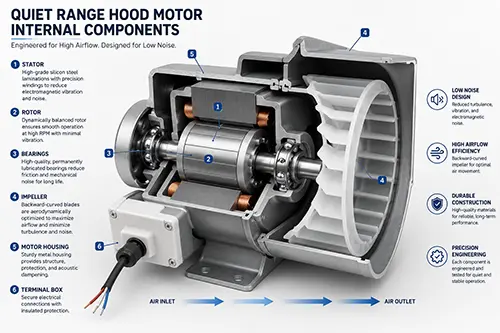
During operation, a motor rotor spins at high velocities. Any asymmetric mass distribution across the rotor generates centrifugal forces, leading to radial vibration. This vibration transmits directly through the motor shaft to the impeller and the surrounding housing. To produce a reliable, quiet range hood motor, manufacturers must implement rigorous dynamic balancing protocols. High-precision balancing minimizes these radial forces, ensuring the motor operates smoothly across all RPM ranges, which is essential for multi-speed hood applications.
The Critical Role of Bearing Quality in Rotational Friction
Bearings serve as the primary mechanical interface between the rotating shaft and the stationary motor housing. Inferior bearings introduce microscopic friction points that manifest as continuous, high-frequency mechanical noise. Premium quiet range hood motors utilize high-grade, permanently lubricated bearings. These components not only drastically reduce rotational friction but also enhance the thermal stability and overall operational lifespan of the motor.
Stator Design and Mitigating Electromagnetic Vibration
Most kitchen hood motors operate on standard 220–240V AC power at a frequency of 50–60Hz. This alternating current creates rapidly oscillating magnetic fields within the stator laminations, which can induce physical micro-movements known as magnetostriction. This phenomenon produces a characteristic low-frequency electromagnetic hum. To combat this, precision OEM manufacturing involves tightly packing the stator laminations and applying specialized varnishes or bonding resins. This structural reinforcement restricts internal lamination movement, significantly dampening electromagnetic acoustic emissions before they can resonate through the motor housing.
The electrical performance of rotating machines is standardized under IEC 60034, which defines internationally accepted requirements for electric motors.
Fluid Mechanics and Aerodynamic Noise Reduction
While mechanical precision mitigates structural vibration, aerodynamic turbulence often dominates the acoustic profile of a kitchen ventilation system at high rotational speeds. A truly quiet range hood motor relies on optimized fluid dynamics to move large volumes of air with minimal resistance and vortex shedding.
Managing Turbulence, Static Pressure, and Moisture Flux
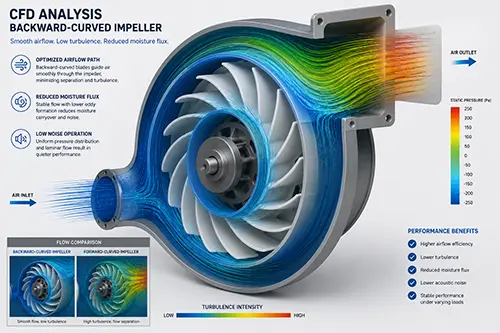
Aerodynamic noise is fundamentally generated by rapid pressure fluctuations within the airflow path. As the impeller accelerates the air, it must overcome the static pressure of the entire ductwork system. Furthermore, kitchen ventilation involves exhausting a complex fluid mixture rather than dry air. The constant introduction of steam and cooking byproducts creates a dynamic moisture flux, which alters the fluid’s density and kinematic viscosity.
This moisture flux can exacerbate boundary layer separation along the impeller blades if the aerodynamic profile is poorly designed. When boundary layer separation occurs, it creates trailing edge wakes and localized turbulence, translating directly into broadband acoustic emissions. Engineering a low-noise motor requires a blade and volute design that maintains attached laminar flow even under varying static pressures and high moisture-content conditions.
Impeller Engineering: Forward Curved vs. Backward Curved Blades
The geometry of the impeller dictates both the airflow characteristics and the resulting aerodynamic noise. As a manufacturer supporting multiple OEM specifications, Electro NASA produces both forward-curved and backward-curved hood motors. Selecting the correct configuration is critical for balancing volumetric efficiency and acoustic performance.
| Engineering Parameter | Forward Curved Impeller | Backward Curved Impeller |
| Blade Geometry | Blades curve in the direction of rotation. | Blades curve against the direction of rotation. |
| Airflow vs. RPM | Delivers high airflow at relatively low operational speeds. | Requires higher RPMs to achieve equivalent volumetric airflow. |
| Static Pressure Handling | Sensitive to static pressure variations; efficiency drops in long duct runs. | Highly resilient to duct resistance; maintains stable airflow under high pressure. |
| Acoustic Profile | Generally quieter at lower operating pressures due to lower RPM requirements. | Exhibits superior acoustic performance in high-pressure systems due to streamlined boundary layer attachment. |
| Power Characteristics | Power consumption increases as static pressure decreases (risk of overloading). | Non-overloading power curve; current draw drops if static pressure drops. |
Utilizing Computational Fluid Dynamics (CFD) for Airflow Optimization
To eliminate the guesswork in impeller and housing design, engineers rely heavily on Computational Fluid Dynamics (CFD). CFD allows for the highly accurate simulation of velocity vectors, pressure distributions, and temperature gradients within the motor housing. By computationally modeling the fluid flow, engineers can pinpoint exact zones of vortex shedding and turbulent kinetic energy that would otherwise generate acoustic noise. Optimizing the attack angle of the blades and fine-tuning the clearances between the impeller and the housing via CFD ensures that the resulting physical prototype maintains a smooth, low-noise aerodynamic profile under load.
Thermodynamic Considerations in Enclosed Motors
Electric motors convert electrical energy into mechanical energy, but inherent inefficiencies—specifically $I^2R$ copper losses in the windings and hysteresis losses in the stator core—generate thermal energy. In the enclosed environment of a kitchen appliance, managing this thermal output is directly tied to maintaining acoustic stability.
Heat Dissipation and Its Impact on Motor Acoustic Stability
When a motor operates continuously, the accumulation of internal heat causes the metallic components to undergo thermal expansion. If heat dissipation is poorly managed, this expansion can alter the microscopic clearances between the rotor and the stator. Even a sub-millimeter shift in the air gap can disrupt the dynamic balancing achieved during manufacturing, introducing low-frequency mechanical vibrations that amplify as the motor reaches its maximum operating temperature.
Additionally, elevated temperatures affect the kinematic viscosity of the bearing lubricants. If the lubricant thins excessively due to heat, the dampening film between the bearing balls and the raceway is compromised, leading to increased metal-on-metal friction and a noticeable spike in high-frequency mechanical noise.
Thermal Protection Integration in Continuous Operation
To prevent acoustic degradation and mechanical failure, premium enclosed motors are engineered with advanced thermal management systems. Electro NASA motors integrate built-in thermal protection to safeguard the unit during continuous operation. This embedded thermal protection ensures the motor remains within its engineered temperature tolerances. By aggressively managing the internal operating temperature, the motor preserves its dynamic balance and bearing lubrication integrity, ensuring the acoustic signature remains consistently low regardless of the runtime duration.
The Impact of Motor Housing Materials on Acoustics
The enclosure that surrounds the motor stator and rotor plays a critical role in acoustic containment. OEM buyers must evaluate the acoustic dampening properties of the motor housing material against the structural requirements of the end product. Electro NASA manufactures quiet range hood motors in both plastic housing and metal housing configurations to support diverse engineering specifications.
Acoustic Dampening Properties of Plastic Housings
High-grade polymeric or plastic housings possess an inherently lower modulus of elasticity compared to metals. This structural characteristic allows the plastic housing to absorb and dissipate high-frequency electromagnetic vibrations rather than transmitting them to the surrounding kitchen appliance chassis. For residential applications where acoustic subtlety is paramount, plastic housing motors often provide superior dampening of internal mechanical noise.
Structural Rigidity and Resonance Control in Metal Housings
Conversely, metal housings offer unmatched structural rigidity and thermal resistance, making them ideal for high-capacity industrial or commercial-grade range hoods. While metals are highly transmissive to sound waves, engineered metal housings combat this by altering the resonant frequency of the enclosure. By increasing the mass and stiffness of the housing, engineers can shift the natural frequency outside the operational RPM range of the motor, preventing resonant amplification.
Electro NASA’s OEM Capabilities for Quiet Hood Motors
Achieving consistent acoustic performance across large manufacturing runs requires stringent quality control and advanced testing facilities. As a dedicated OEM supplier, Electro NASA integrates rigorous acoustic testing into the production of its high-performance units, including the Turbo Series.
Specialized Engineering in the Turbo Series
The Turbo Series is engineered specifically to maximize volumetric airflow while suppressing acoustic output. By optimizing the internal geometries and utilizing dynamically balanced impellers, Electro NASA provides hood manufacturers with a drop-in solution that elevates the acoustic profile of their premium kitchen appliances.
Learn more about the engineering features of our Turbo Series ventilation motors developed specifically for OEM manufacturers.
Quality Control and Laboratory Acoustic Testing Standards
Every quiet range hood motor must meet exact baseline performance metrics before leaving the manufacturing facility. Electro NASA’s internal testing laboratory evaluates continuous current stability, RPM variance, and thermal thresholds to ensure that each unit maintains its low-noise characteristics throughout its designated operational lifespan.
Integration Guidelines for Kitchen Hood Manufacturers
Even the most precisely engineered electric motor will generate noise if integrated poorly into the kitchen hood. OEM design teams must implement advanced mounting and vibration isolation techniques. Utilizing elastomeric vibration isolators (such as rubber grommets or silicone mounts) between the motor chassis and the metal hood canopy severs the acoustic bridge, preventing motor vibrations from utilizing the hood structure as an amplifying soundboard.
Purchasing Criteria for Technical Procurement Managers
When specifying a quiet range hood motor, technical procurement managers must ensure the electrical characteristics align with regional infrastructure. Motors must be specified for 220–240V AC and 50–60Hz frequencies to ensure stable magnetic flux. Furthermore, procurement teams should analyze the correlation between airflow volume and noise, selecting non-overloading motors that maintain stability across varying static pressures. Long-term supplier reliability and robust R&D support from established manufacturers like Electro NASA are critical for ongoing product development.
Maintenance and Longevity of Low-Noise Systems
Acoustic degradation over time is a primary failure mode in kitchen ventilation. Airborne grease and particulate matter bypass primary filters and deposit on the impeller blades. This asymmetric mass accumulation destroys the rotor’s dynamic balance, reintroducing radial vibration and mechanical noise. Ensuring the longevity of a low-noise system requires selecting motors with tightly sealed, permanently lubricated bearings that resist environmental contamination, preserving the baseline acoustic signature for years of continuous operation.
FAQ
Q: Can a high-CFM range hood motor truly be quiet?
A: Yes, a high-CFM (Cubic Feet per Minute) motor can operate quietly if it relies on aerodynamic efficiency rather than sheer RPM. By utilizing optimized backward-curved impellers and maintaining tight dynamic balancing, high volumes of air can be moved against static pressure without inducing excessive acoustic turbulence or mechanical vibration.
Q: What is the difference between AC and DC motors regarding noise?
A: AC motors rely on alternating current, which can produce a low-frequency electromagnetic hum (magnetostriction) within the stator laminations. Brushless DC (BLDC) motors operate via electronic commutation, often resulting in lower electromagnetic noise and reduced bearing friction. However, precision-engineered AC motors with tightly bonded stators and high-grade bearings can achieve comparable acoustic performance in kitchen hood applications.
Q: How do backward-curved impellers reduce acoustic output? A: Backward-curved impellers are aerodynamically designed to curve against the direction of rotation. This geometry allows the blades to maintain smooth boundary layer attachment under high static pressure conditions, effectively preventing vortex shedding and the resulting broadband aerodynamic noise that typically occurs in complex ductwork systems.
Request Quiet Motor Specifications
Are you engineering a premium kitchen appliance that requires exceptional acoustic performance? Partner with Electro NASA for OEM-grade ventilation solutions. [Request Quiet Motor Specifications] to review our technical data, acoustic testing reports, and custom manufacturing capabilities for your next product line.