How to Request and Validate an OEM Range Hood Motor Prototype
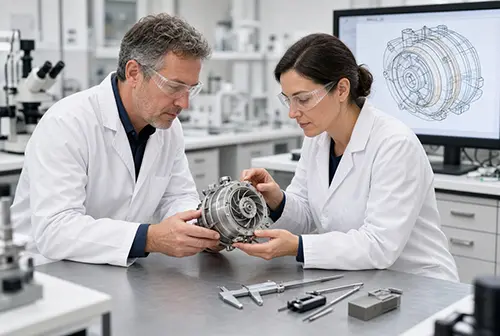
For OEM appliance manufacturers, transitioning a new range hood from the R&D lab to the mass assembly line requires absolute engineering certainty. Ordering thousands of units based on a generic specification sheet is a recipe for assembly line bottlenecks, acoustic failure, and voided warranties. Before committing to bulk production, R&D engineers must secure and validate a fully functional OEM range hood motor prototype.
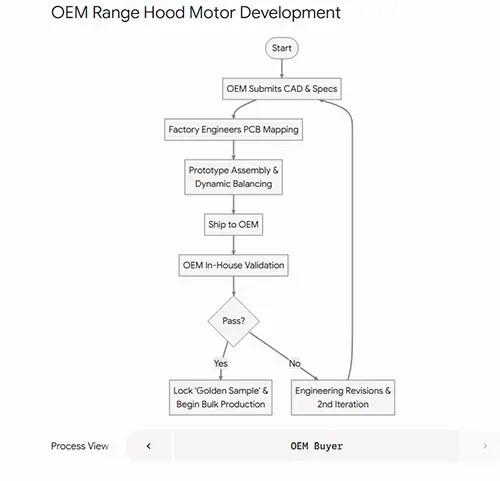
Prototyping is not simply about checking physical dimensions; it is a collaborative engineering phase. It is the moment when the factory customizes the motor’s electrical mapping to communicate seamlessly with your proprietary Printed Circuit Board (PCB), and calibrates the aerodynamic output to match the static pressure of your specific hood chassis.
This guide provides R&D engineers and procurement managers with a structured roadmap for requesting, customizing, and validating centrifugal blower prototypes to ensure flawless mass production integration — you can browse our custom OEM blower customization options directly while you plan.
The Critical Role of Prototyping in Appliance Manufacturing
A primary industrial manufacturer, such as Nam Avarane Sanaye Arvin Co. (Electro NASA), views the prototype phase as a mandatory risk-mitigation strategy. While trading companies simply pull a standard motor off a shelf and mail it as a “sample,” an engineering-driven factory uses this phase to tailor the winding, the assembly, and the wiring harness to your exact appliance architecture.
A successfully validated prototype becomes the immutable “golden sample.” Once approved by your R&D team, the ISO 9001:2015 audited assembly line guarantees that every unit in the subsequent bulk order matches that exact standard.
The 4-Step Prototype Request Process
To prevent unnecessary iteration cycles, OEM buyers must provide specific technical data to the manufacturer during the initial RFQ.
1. Supply Dimensional Constraints and Hood Architecture
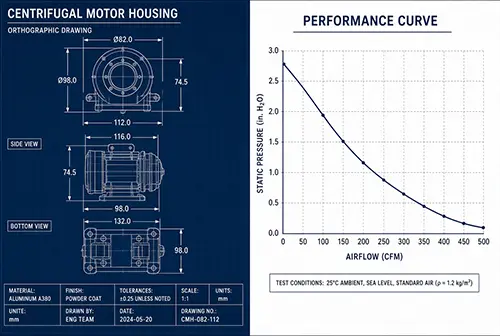
Begin by exchanging precise dimensional CAD files. The factory needs to know the exact volumetric space available inside your hood chassis, the mounting point geometries, and the exhaust outlet diameter (e.g., 120mm vs. 150mm). This determines whether a compact plastic K30 motor or a wide-canopy Turbo series motor is required.
2. Define Aerodynamic Requirements (CFM vs. Static Pressure)
Do not just request a “high power” motor. Provide the factory with your target airflow (m³/h or CFM) and the expected ducting restrictions, evaluated against the ANSI/ASHRAE 51 (ANSI/AMCA 210) laboratory testing standard for fan aerodynamic performance. The factory will consult their aerodynamic performance curves to determine the correct impeller geometry.
- Backward-curved impellers: Backward-curved impellers Specified for appliances that will vent through long, restrictive ductwork.
- Forward-curved impellers: Specified for high-volume extraction in wide canopy or island hoods with shorter duct runs.
3. Specify PCB Integration and Speed Mapping
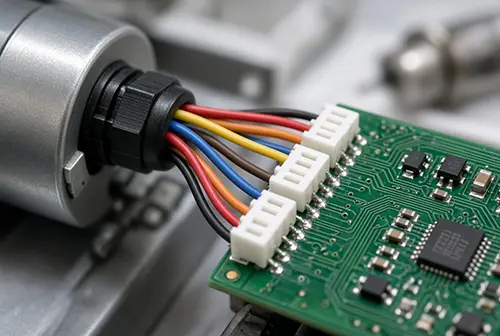
Modern appliances utilize capacitive touch controls or smart home interfaces. If your hood requires variable extraction rates, inform the factory. Electro NASA specializes in custom 1-to-8 speed PCB mapping for single-phase AC motors, engineering the internal copper windings to match your specific switchboard logic.
4. Determine Acoustic and Vibration Tolerances
Specify your maximum acceptable decibel (dB) rating. This informs the factory’s dynamic balancing team of the exact micro-calibration tolerances required to prevent the motor from transferring kinetic resonance into your metal appliance housing.
Advanced Customization: Capacitor-Less Architecture
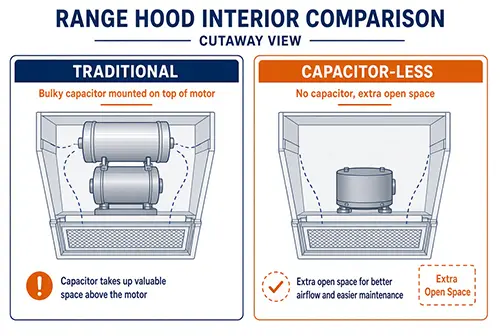
A major innovation OEM engineers should consider during the prototyping phase is adopting a capacitor-less architecture (or external capacitor design), particularly for the K30 series.
Traditional motors house a bulky capacitor inside or attached directly to the motor volute. By removing this component and integrating the capacitance requirements directly onto the appliance’s main electronic PCB, R&D teams gain two massive advantages:
- Space Optimization: It frees up critical space inside concealed or telescopic hoods.
- Assembly Speed: It creates a cleaner wiring harness, reducing assembly line time for your factory workers.
How to Validate the Prototype Upon Arrival
Once the Electro NASA prototype arrives at your facility, it must undergo rigorous in-house validation before you authorize bulk production.
Mechanical Fit and Finish
First, install the motor into your physical hood chassis. Verify that the mounting brackets align perfectly with your CAD designs and that the weld-less galvanized housing (or needle-flame plastic volute) clears all internal appliance structures without interference.
Electrical Validation (Hi-Pot and Thermal Load)
Your electrical engineers must connect the motor to your proprietary PCB. Validate that all requested speed mappings function smoothly without electrical stuttering. Subject the prototype to a simulated heavy-duty cooking cycle (high heat) to verify that the Class 180/200 insulation and the auto-resetting thermal protector operate safely, in line with IEEE 43 insulation resistance testing practices for electric machinery. (Perform your own Dielectric Withstand/Hi-Pot test to confirm factory data).
Acoustic Chamber Testing
Mount the fully assembled range hood inside an acoustic testing chamber. A motor that sounds quiet on a testing bench can cause severe rattling when bolted to a thin stainless-steel canopy. Verify that the factory’s precision dynamic balancing holds true when the motor is operating under load within your appliance.
Common Prototyping Mistakes OEMs Must Avoid
- Testing Outside the Chassis: Never validate a motor’s acoustic profile while it is sitting on a desk. It must be tested inside the final appliance chassis to account for resonance.
- Ignoring Voltage Fluctuations: Ensure you test the prototype at both the low and high ends of your target market’s voltage range (e.g., 220V – 240V / 50Hz – 60Hz) to ensure the copper windings perform consistently.
- Failing to Lock the Spec: Once a prototype passes validation, ensure the manufacturer locks the exact bill of materials (BOM). Dealing with a primary manufacturer like Electro NASA guarantees that the bulk order will mirror the approved prototype exactly.
Frequently Asked Questions
How long does it take to receive a custom OEM motor prototype? Lead times for prototypes vary based on customization. A standard unit might ship in a few days, whereas a motor requiring custom 1-to-8 speed PCB mapping and specific aerodynamic adjustments generally takes 2 to 3 weeks to engineer, balance, and test before shipping.
What is an aerodynamic performance curve, and why do I need it? An aerodynamic performance curve is a graph that plots the motor’s volumetric airflow (CFM or m³/h) against the static pressure (resistance) in a duct system. R&D engineers need this to guarantee the hood will extract smoke effectively even if the end-user installs long or winding exhaust ducts.
Can we request a prototype with a specific insulation class? Absolutely. If your appliance is a commercial-grade or high-BTU prosumer range hood, you should explicitly request a prototype wound with Class 180 or Class 200 thermal insulation to prevent coil burnout.
Do we pay for OEM prototypes? Policies vary, but generally, primary manufacturers charge a nominal fee for highly customized engineering prototypes. However, this cost is almost always credited back to the OEM buyer’s account once the bulk production order is finalized.
Ready to move your appliance from R&D to mass production?Request an OEM Quotation & Production Lead Time to begin the prototyping process.
Require custom electrical architecture for a smart appliance? Consult with Electro NASA Technical Sales Engineers to discuss tailored PCB speed mapping.