K30 Motor RPM: How Speed Affects Hood Performance
For OEM appliance designers and R&D electrical engineers, specifying the rotational speed of a centrifugal blower is a critical balancing act. The K30 motor RPM (Revolutions Per Minute) dictates the fundamental performance of the range hood, directly influencing its volumetric airflow (CFM), its ability to overcome duct resistance, and its overall acoustic footprint.
While it is tempting to simply operate a motor at its absolute maximum RPM to achieve the highest possible extraction rate, doing so without precise fluid dynamic calculation often leads to severe mechanical vibration and unacceptable decibel (dB) levels.
This engineering guide explores the physics of motor rotational speed, explaining how Electro NASA’s K30 series manages high-RPM stability and how OEM teams can map highly customized speed configurations to their proprietary printed circuit boards (PCBs).
The Physics of Motor Rotational Speed (RPM)
In single-phase AC centrifugal motors, the rotational speed is governed by the frequency of the electrical supply (50Hz or 60Hz) and the number of magnetic poles in the stator. According to standard HVAC fan laws, the relationship between RPM and aerodynamic output is highly predictable:
- Airflow (CFM): Varies directly with RPM. If you increase the speed by 10%, your volumetric airflow increases by 10%.
- Static Pressure: Varies by the square of the RPM. A 10% increase in speed yields a 21% increase in the motor’s ability to overcome duct resistance.
- Power Consumption: Varies by the cube of the RPM.
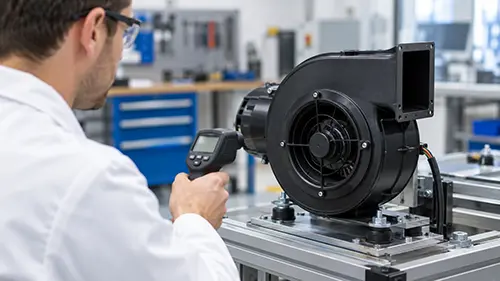
This exponential relationship underscores why controlling K30 motor speed is vital for OEMs. Running a motor at maximum RPM unnecessarily consumes vast amounts of electrical power and generates excess heat, which the K30 safely mitigates using its Class 180 (Class H) insulation.
How Static Pressure Impacts K30 Motor Speed
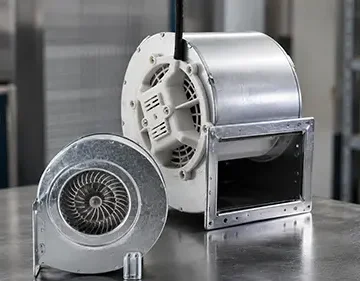
The K30 1111/1115 and 1113/1117 models are engineered with a backward-curved impeller, designed specifically for high static pressure environments (such as long, restrictive ductwork).
Unlike forward-curved fans that risk stalling or overloading when faced with duct resistance, the backward-curved geometry allows these K30 models to maintain a highly stable RPM curve. When the static pressure inside the kitchen exhaust system rises, they rely on their torque to sustain rotational speed, pushing the air through the restriction with only a minimal, predictable drop in overall CFM.
Managing Acoustic Resonance at High RPMs
The most significant engineering challenge associated with high RPM operation is acoustic resonance. As rotational speed increases, any microscopic imbalance in the motor’s rotor or impeller generates eccentric kinetic forces. When bolted to a thin stainless-steel appliance canopy, this imbalance transfers directly to the chassis, resulting in severe metallic rattling and low-frequency humming.
The Role of Precision Dynamic Balancing
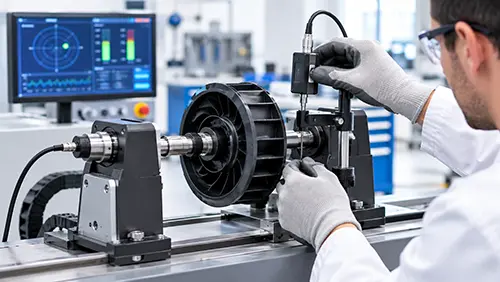
To neutralize high-RPM vibration, Electro NASA subjects every K30 unit to precision dynamic balancing.
Unlike static balancing, dynamic balancing spins the fully assembled motorized impeller at operational speeds. Laser and acoustic sensors map the vibration footprint across multiple axes. Micro-weights are then applied (or material removed) until the eccentric forces are entirely eliminated. This strict quality control ensures that even when the K30 operates at maximum RPM over a high-BTU gas range, it remains operationally smooth, allowing appliance brands to market their hoods as “super-silent.”
Engineering 1-to-5 Speed PCB Mapping for the K30 Series
Modern prosumer range hoods utilize capacitive touch panels that offer users granular control over their extraction rates. To achieve this, OEM electrical engineers must manipulate the AC voltage delivered to the motor to control its RPM.
Electro NASA supports custom 1-to-5 speed PCB mapping for the K30 series.
By utilizing relay switches or solid-state Triacs on the appliance’s main board, engineers can step down the voltage fed to the motor’s copper windings. This lowers the torque, intentionally inducing a calculated slip in the magnetic field, which smoothly reduces the RPM.
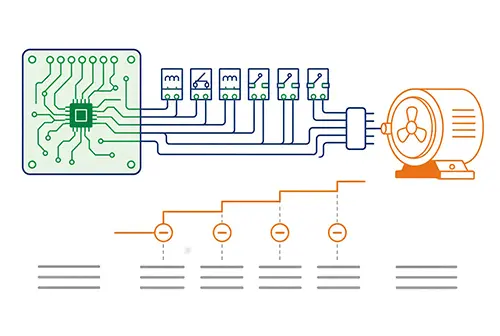
Engineering Tip: When mapping 5 distinct speeds, ensure the lowest speed setting (Speed 1) provides enough voltage to overcome the motor’s starting inertia. If the voltage is stepped down too far, the motor may hum without rotating, leading to rapid localized heating within the stator.
OEM Selection Matrix: Balancing Speed, Material, and Application
Use this matrix to understand how different K30 models handle high RPMs based on their physical materials and intended applications.
| K30 Model | Volute Material | RPM Application Focus | Ideal OEM Appliance Architecture |
|---|---|---|---|
| K30 1111 / 1115 | Fire-Retardant Plastic (Backward-Curved) | High RPM / Rapid acceleration | Lightweight, concealed hoods requiring fast extraction response. |
| K30 1113 / 1117 | Weld-Less Galvanized (Backward-Curved) | Sustained High RPM / High Heat | Commercial-grade or prosumer hoods over high-BTU ranges. |
| K30 3111 / 3112 | Ultra-Compact Plastic (Forward-Curved) | Variable RPM / Recirculating | Built-in ductless models pushing through dense charcoal filters. |
Regardless of the material chosen, all K30 models utilize self-lubricating bearings to ensure the rotational mechanics remain frictionless, extending the lifespan of the motor even under continuous high-speed duty cycles.
Frequently Asked Questions
How does a 50Hz vs. 60Hz power supply affect motor RPM?
Because the rotational speed of an AC induction motor is tied to the frequency of the electrical grid, a K30 motor will naturally spin approximately 20% faster on a 60Hz grid (e.g., in North America) compared to a 50Hz grid (e.g., in Europe). Electro NASA engineers the K30 to be dual-rated, ensuring the Class 180 insulation and bearings can handle the higher RPMs of a 60Hz environment without failing.
Can we use a Variable Frequency Drive (VFD) to control the K30’s speed?
While VFDs provide exceptional speed control by altering the AC frequency, they are generally too bulky and expensive for standard residential range hoods. Instead, OEM appliance manufacturers typically rely on voltage-stepping (via relays or Triacs on the PCB) to achieve 1-to-5 speed mapping cost-effectively.
Why does my prototype motor rattle only at Speed 3, but is quiet at Speed 4?
This phenomenon is known as hitting a resonant frequency. Every physical structure (including your metal hood chassis) has a natural frequency. If the motor’s RPM at “Speed 3” happens to perfectly match the chassis’s natural frequency, it amplifies the vibration. R&D teams must adjust the voltage mapping for that specific speed setting to shift the RPM away from the resonant zone.
Will running the K30 at low RPMs cause it to overheat?
In some generic motors, running at low RPMs reduces the cooling airflow over the stator, leading to overheating. However, the K30 series is protected by Class 180 (Class H) thermal insulation. This ensures the copper windings remain safe from thermal breakdown even during extended low-speed simmering operations.
Deliver powerful, vibration-free extraction to your customers. Request an OEM Quotation & Production Lead Time for dynamically balanced K30 series motors.
Require assistance mapping multi-speed touch controls to an AC induction motor? Consult with Electro NASA Technical Sales Engineers for specialized PCB integration support.