
Forward vs. Backward Curved Range Hood Motors: An OEM Engineering Guide
For OEM appliance designers and R&D engineers, selecting the correct centrifugal blower is not simply a matter of comparing raw wattage. The aerodynamic success of a range hood—its ability to extract smoke efficiently while maintaining strict acoustic tolerances—is fundamentally dictated by impeller geometry.
The debate between using a backward vs forward curved centrifugal fan comes down to navigating the fluid dynamic relationship between volumetric airflow (CFM or m³/h) and static pressure (resistance in the ductwork). Choosing the wrong impeller geometry can result in motor stalling, electrical overloading, or severe acoustic resonance inside the appliance chassis.
This engineering guide breaks down the thermodynamic and aerodynamic properties of both impeller types, providing OEM teams with a technical framework for component selection — you can browse our OEM blower aerodynamics options directly while you evaluate.
Understanding Fluid Dynamics in Range Hood Extraction
To evaluate impeller performance, engineers must balance two opposing forces:
- Volumetric Airflow (CFM / m³/h): The absolute volume of air the motor moves in a given timeframe.
- Static Pressure (Pa or in.WG): Static Pressure (Pa or in.WG): The resistance the air encounters as it is pushed through filters, bends, and the physical length of the exhaust ducting, as characterized by ASHRAE’s Technical Committee on Fans.
As static pressure increases (e.g., venting a hood through 15 feet of winding ductwork), volumetric airflow inherently decreases. The severity of this drop-off depends entirely on the curvature of the impeller blades.
Forward-Curved Impellers: High Airflow in Compact Spaces
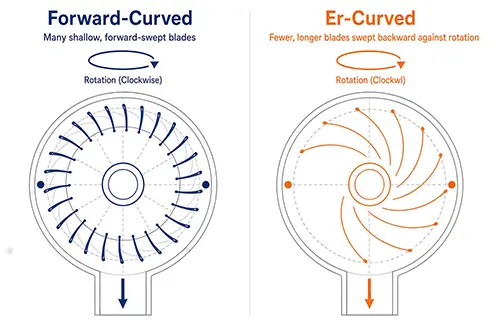
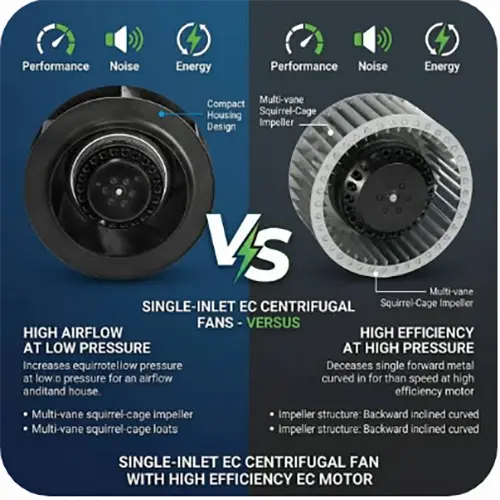
Forward-curved impellers feature numerous shallow blades that curve in the direction of the fan wheel’s rotation. Often referred to as “squirrel cage” blowers, they rely on high kinetic energy at the blade tips to accelerate the air forward into a scroll housing.
Aerodynamic Profile and Function
Forward-curved fans operate at relatively low speeds (RPM) while generating massive volumetric airflow. Because they move large amounts of air gently, they are incredibly quiet. However, their primary aerodynamic limitation is an intolerance for high static pressure. If duct resistance increases significantly, a forward-curved fan will experience a rapid loss of CFM, and in extreme cases, the motor can overload if the system is starved of air.
Best OEM Applications (Turbo Series)
Because they generate high airflow at lower speeds, forward-curved impellers are ideal for appliances where space is limited but extraction volume must remain high.
- Wide-Canopy and Island Hoods: The Turbo Series high-efficiency OEM blowers utilize twin forward-curved impellers on a dual-shaft architecture to provide symmetrical, high-volume extraction across large cooking surfaces.
- Short Ducting/Recirculating Systems: Perfect for apartment installations or built-in cabinets where duct runs are short and static pressure is minimal.
Backward-Curved Impellers: High Static Pressure Resistance
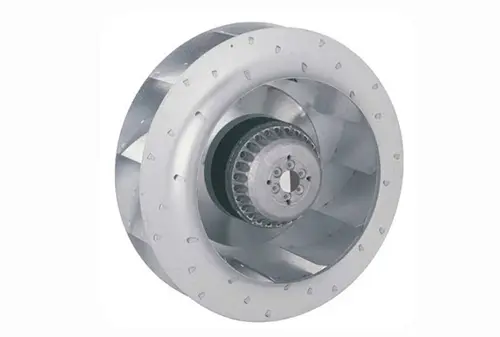
Backward-curved impellers feature fewer, longer blades that curve away from the direction of rotation. Instead of throwing air forward, they draw air through the blade channels, compressing it and utilizing centrifugal force to push it outward.
The Non-Overloading Characteristic
The defining engineering advantage of a backward-curved fan is its non-overloading characteristic. As static pressure (duct resistance) increases, a backward-curved motor will smoothly overcome the resistance while experiencing a much slower, more stable reduction in CFM. Furthermore, unlike forward-curved fans, peak power consumption occurs at the midpoint of its performance curve. Even if the duct is completely unrestrictive, the motor will not draw excess current and burn out.
Best OEM Applications (K30 Series)
Backward-curved motors are the heavy-duty workhorses of the HVAC industry. They are designed for environments where fluid dynamic resistance is the primary obstacle.
- Long and Complex Ducting: The K30 Series heavy-duty exhaust fan motors utilize backward-curved impellers to guarantee smoke extraction even when the appliance is vented through complex, multi-story architectural ductwork.
- High-End Prosumer Hoods: Capable of maintaining high static pressure extraction over intense, commercial-grade gas ranges.
Aerodynamic Performance Curves: CFM vs. Static Pressure
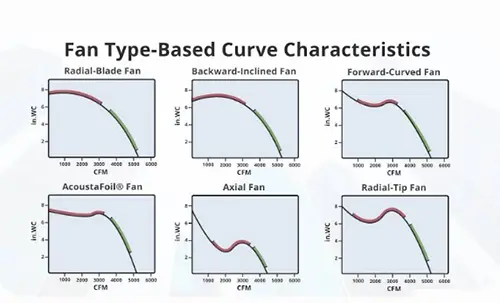
To truly understand the difference, engineers must plot these motors on an aerodynamic performance curve — see Engineering Toolbox’s fan affinity laws for the underlying math on how speed and diameter changes affect airflow and pressure.
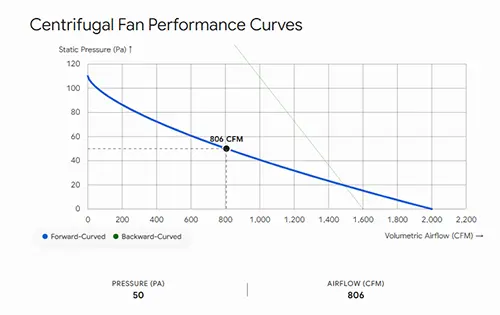
As the data shows, forward-curved fans (top right) experience a steep “dip” in performance as pressure rises, whereas backward-curved fans (top middle) maintain a smooth, predictable aerodynamic arc.
OEM Selection Matrix: Which Impeller to Choose?
Use the following decision matrix to select the correct Electro NASA motor architecture for your upcoming appliance design.
| Engineering Requirement | Recommended Impeller | Electro NASA Series | Aerodynamic Reason |
|---|---|---|---|
| Max Airflow in Small Space | Forward-Curved | Turbo 2114 / 2120 | Blades generate high kinetic energy at lower RPMs, saving space. |
| Long / Complex Duct Runs | Backward-Curved | K30 1111 / 1115 | High static pressure capabilities prevent the motor from stalling. |
| Symmetrical Wide-Canopy Extraction | Forward-Curved (Twin) | Turbo 2113 / 2115 | Dual impellers cover a wider surface area efficiently and quietly. |
| Extreme Thermal/Continuous Duty | Backward-Curved | K30 1113 / 1117 (Metal) | Non-overloading electrical profile prevents coil burnout under heavy load. |
Best Practices for Integrating Motor Aerodynamics
- Demand Dimensional CAD Files Early: A backward-curved impeller often requires a slightly larger scroll housing to function efficiently. Ensure your physical hood chassis has the volumetric space to accommodate the correct volute geometry before committing to a design.
- Specify Acoustic Tolerances: While forward-curved fans are naturally quieter due to lower RPMs, both types must undergo precision dynamic balancing. A poorly balanced backward-curved fan will transfer extreme kinetic vibration to your appliance chassis.
- Evaluate Filter Resistance: The type of grease filter you use (e.g., dense stainless steel baffle filters vs. aluminum mesh) directly adds to the static pressure of the system. If using heavy baffle filters, lean toward backward-curved (K30) architecture to pull air through the restriction.
Frequently Asked Questions
Why do forward-curved fans risk electrical overloading? If a forward-curved fan is operated without the expected static pressure (e.g., running the motor freely without ducting or filters attached), it will move far more air than intended. This requires more torque, causing the motor to draw excess electrical current, which can lead to thermal burnout. Backward-curved fans are naturally non-overloading and will not draw destructive current under these conditions.
Can I use a backward-curved impeller for a ductless (recirculating) hood? Yes. While recirculating hoods do not have long ducts, the air must be pushed through dense charcoal carbon filters. These filters create massive static pressure. A backward-curved motor (like the K30 3111/3112 series) is highly effective at overcoming this specific restriction.
Are backward-curved motors louder than forward-curved motors? Generally, yes. Because they must spin at higher RPMs to generate equivalent volumetric airflow against pressure, they produce slightly higher decibel (dB) levels. However, Electro NASA’s precision dynamic balancing mitigates the mechanical vibration that usually exacerbates this noise in standard appliances.
What material is best for centrifugal impellers? It depends on the application. For standard or highly compact designs, needle-flame standard fire-retardant plastic is lightweight and cost-effective. For high-end commercial, coastal, or extreme-temperature environments, galvanized steel impellers are required for their thermodynamic resilience.
Ensure your appliance extracts flawlessly in any architectural environment. Request an OEM Quotation & Production Lead Time for our K30 and Turbo series motors.
Not sure which impeller geometry fits your chassis? Consult with Electro NASA Technical Sales Engineers for a comprehensive fluid dynamic evaluation.
