
Range Hood Motor Lead Times: What Buyers Should Ask Manufacturers
For OEM procurement managers and production planners, an unpredictable range hood motor lead time is a critical vulnerability. When component shipments are delayed, appliance assembly lines halt, seasonal product launches are missed, and warehousing costs skyrocket.
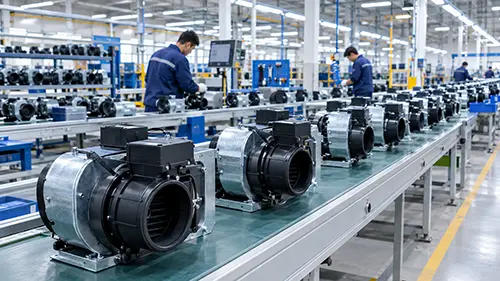
In the industrial motor sector, the lead time provided on a quotation is often an estimate based on perfect conditions. However, manufacturing centrifugal blowers at scale requires orchestrating custom electrical mapping, raw material sourcing, precision dynamic balancing, and rigorous acoustic testing. If a supplier lacks in-house capabilities for any of these steps, minor disruptions quickly compound into massive supply chain delays.
This guide breaks down the actual phases of wholesale extractor fan supply, highlighting the bottlenecks and providing OEM buyers with the exact questions needed to verify a manufacturer’s true production capacity. If you’d like to see current specs while you plan, you can check bulk range hood motor delivery options directly.
The Difference Between Quoted and Actual Manufacturing Lead Times
Production Lead Time is the total time elapsed from the moment a purchase order is approved to the moment the goods are loaded onto a vessel at the port of origin. (This does not include ocean transit time).
Third-party trading companies often quote aggressive lead times to win contracts, but because they do not control the factory floor, they cannot guarantee the schedule. A primary industrial manufacturer controls the machinery, the labor force, and the raw materials, resulting in a predictable and stable lead timeline.
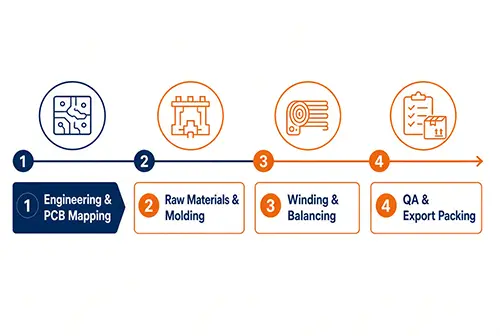
The 4 Phases of OEM Blower Production
To accurately forecast delivery, procurement teams must understand what happens during the manufacturing window.
Phase 1: Engineering and Custom PCB Mapping
If you are ordering a standard 3-speed motor, this phase is brief. However, if your appliances utilize capacitive touch panels, the factory must program a custom 1-to-8 speed PCB mapping for the AC single-phase motor. This requires engineering collaboration, prototype validation, and sign-offs before mass production can begin.
Phase 2: Raw Material Allocation and Injection Molding
Factories must secure electrical steel for stators, copper for windings, and materials for the volute. If you order K30 Series heavy-duty exhaust fan motors with fire-retardant plastics, the factory must initiate specific injection molding cycles using needle-flame standard polymers. Sourcing these specialized industrial materials can create bottlenecks if the factory does not maintain adequate safety stock.
Phase 3: Winding, Assembly, and Dynamic Balancing
This is the core manufacturing phase. Automated copper winding machines apply the coils, and the components are assembled into weld-less galvanized or plastic housings. A critical, time-consuming step is precision dynamic balancing. Every rotor and impeller must be micro-calibrated to eliminate eccentric forces and prevent metallic resonance in the final appliance.
Phase 4: ISO 9001:2015 Batch Testing and Export Packing
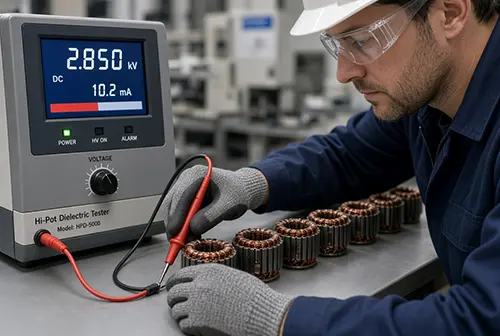
Before shipment, motors undergo rigorous QA. This includes dielectric withstand testing (Hi-Pot) to verify Class 180 or Class 200 thermal insulation integrity, as well as acoustic chamber testing. Rushing this phase to meet a tight deadline invariably leads to defective units reaching your assembly line.
5 Questions OEM Buyers Must Ask Motor Manufacturers
To separate genuine industrial manufacturers from brokers, ask these five questions during the RFQ process:
- Do you perform dynamic balancing and injection molding in-house? Why it matters: Sub-contracting these core processes is the leading cause of unpredictable lead time delays.
- What percentage of your total production capacity is currently allocated? Why it matters: A factory running at 99% capacity has no buffer for unexpected machinery downtime, guaranteeing delays for new orders.
- Are your lead times contingent on raw material deliveries? Why it matters: Established factories warehouse their own copper and galvanized steel to insulate buyers from raw material supply shocks.
- What is your historical export volume? Why it matters: Factories inexperienced with international shipping often face delays during port customs clearance.
- How long does your ISO 9001:2015 batch testing take? Why it matters: If the supplier claims testing takes only a few hours for a bulk order, they are skipping critical thermal and acoustic validations.
Trading Companies vs. Direct Factories: Supply Chain Reliability
When evaluating a factory direct motor supply timeline against a broker’s quote, the operational control dictates reliability.
| Supply Chain Factor | Direct Factory (Electro NASA) | Third-Party Trading Company | Risk to OEM Buyer |
|---|---|---|---|
| Production Control | 100% In-house machinery | Relies on sub-contractor availability | Brokers cannot prioritize your order during peak seasons. |
| Quality Delays | Minimal (QA is integrated into assembly) | High (QA fails require returning goods to sub-contractors) | Failed batches cause sudden, weeks-long delays. |
| Communication | Direct line to factory engineers | Filtered through sales reps | Engineering adjustments pause production while awaiting translation. |
How Electro NASA Ensures Stable Export Logistics
Established in 1999, Nam Avarane Sanaye Arvin Co. (Electro NASA) was built to support high-volume OEM manufacturing. By maintaining total control over injection molding, winding, and weld-less assembly, Electro NASA eliminates sub-contractor bottlenecks.
Furthermore, Electro NASA routinely exports over 30% of its production capacity. This deep logistical experience means the factory has established, streamlined processes for container loading, port staging, and customs documentation, ensuring that once production is complete, your motors do not sit idle waiting for export clearance.
Best Practices for Mitigating Component Delays
- Provide Annual Forecasts: Do not wait until your inventory is depleted to issue a PO. Provide your supplier with a 12-month rolling forecast so they can allocate copper and steel in advance.
- Standardize Housings: If you require different electrical speeds across your appliance lineup, standardize the physical motor housing (e.g., using the exact same weld-less galvanized chassis for all models). This allows the factory to continuously produce the hardware and only alter the final electrical mapping, significantly speeding up production.
Engineering Tip: Always factor in a 10-day buffer period between the factory’s stated lead time and your internal “drop-dead” assembly line requirement date. This follows standard supply chain risk management practice and absorbs minor logistical fluctuations at the port of origin.
Frequently Asked Questions
How does ordering motors with Class 200 insulation affect production time? Applying high-grade thermal insulation like Class 180 or Class 200 requires specialized varnishing and curing processes. While this slightly extends the assembly phase compared to basic Class 130 motors, it is a necessary investment to prevent thermal burnout in high-BTU appliance applications.
Can we expedite an order if we skip prototype validation? Skipping prototype validation is highly discouraged. While it may shave a week off the initial lead time, failing to validate PCB integration and acoustic resonance before bulk manufacturing frequently results in an entire container of incompatible motors, causing catastrophic production delays.
How do seasonal fluctuations affect motor manufacturing lead times? Global supply chains experience significant congestion leading up to major holidays (such as the Lunar New Year or end-of-year retail rushes). Procurement managers must place bulk orders at least 60 to 90 days prior to these known blackout periods to secure factory floor space — and should confirm their minimum order quantities well ahead of these windows.
Why does dynamic balancing add time to the production schedule? Dynamic balancing is not a simple automated task; it requires micro-calibrating every individual rotor and impeller to eliminate eccentric weight. While it adds a specific timeframe to Phase 3 of production, it is the only way to guarantee a “super-silent” operation and prevent metallic rattling in the final range hood.
Call to Action
Secure a reliable supply chain with predictable, factory-direct lead times. Request an OEM Quotation & Production Lead Time today for your next bulk order.
Streamline your engineering phase to accelerate production. Download Dimensional CAD Files & Aerodynamic Performance Curves to begin immediate integration planning.
Need to adjust your appliance PCB to accommodate multi-speed blowers? Consult with Electro NASA Technical Sales Engineers to ensure seamless electrical mapping.
