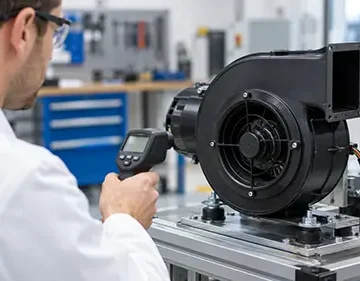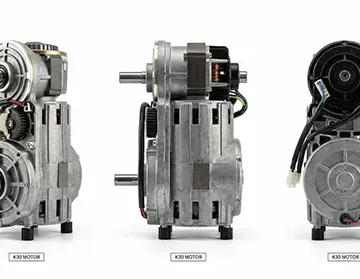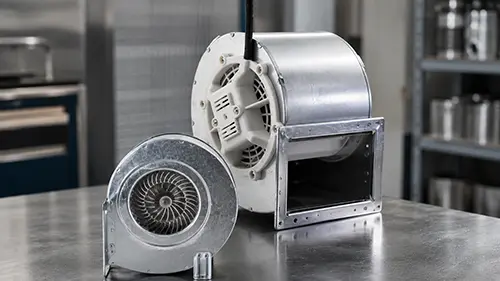
K30 Motor Power Ratings Explained for Range Hood Applications
The K30 motor power rating spans 350W to 750W, depending on voltage configuration and housing variant, with supply options of 110V, 220V, or 240V at 50Hz or 60Hz. Manufactured by Namavaran Sanaye Arvin Co., trading as ElectroNasa, the K30 series is built around a heavy-duty 30mm stator and delivers rated airflow of 2,800 to 4,500 CFM depending on the housing configuration. This guide explains what the power rating means, how it is achieved, and how to select the right K30 configuration for a specific range hood design.
What Is the K30 Motor Power Rating?
The K30 power rating is the electrical input, expressed in watts, that the motor consumes to sustain its rated airflow and rotational speed. Across the series, this ranges from 350W to 750W, with the exact figure depending on voltage, housing, and OEM customization. The rating is paired with a corresponding amperage draw of 3.2A to 5.5A at full load.
Power alone does not describe performance. The K30 rating is meaningful only alongside its supporting figures: rotational speed, airflow, and the static pressure at which that airflow is sustained. A specifier comparing motors by power output alone risks selecting the wrong unit for the ductwork it will actually face.
K30 Motor Technical Specifications
The table below summarizes the baseline technical data for the K30 series, as published by the manufacturer.
| Specification | K30 Series Data |
| Motor Type | Centrifugal (snail blower) fan motor |
| Voltage Options | 110V / 220V / 240V, single-phase or three-phase |
| Frequency | 50Hz / 60Hz |
| Rated Power / Electrical Input | 350W – 750W |
| Amperage Draw | 3.2A – 5.5A at full load |
| Rotational Speed | 1050 / 1400 / 1600 RPM, multi-speed |
| Max Airflow | 2,800 – 4,500 CFM, depending on housing |
| Rated Static Pressure | Holds 1400 RPM up to 1.5 in. w.g. |
| Insulation Class | Class F (155°C insulation thermal-class limit) |
| Ingress Protection | IP54 / IP55 |
| Noise Level | 58 – 65 dB at full velocity |

These figures represent the standard K30 platform. OEM buyers should confirm exact values for a specific SKU and voltage configuration before finalizing a design, since power and airflow shift together with housing and voltage selection.
How Voltage, Frequency, and Amperage Affect K30 Power Output
The K30 is engineered to run across 110V, 220V, and 240V supplies at either 50Hz or 60Hz, in both single-phase and three-phase configurations. At 220V, the motor draws a maximum of 5.5A under full load. Circuit capacity, motor protection, wiring, and applicable electrical requirements should be verified before installing multiple units on the same supply.
Voltage stability directly affects sustained output. A motor supplied below its rated voltage draws more current to maintain the same torque, which raises winding temperature and increases long-term wear. Because the K30 uses Class F insulation, its winding insulation system is designed for the applicable thermal class limit. However, the permissible ambient operating temperature depends on the specific motor configuration and should be confirmed from the manufacturer’s datasheet. Voltage stability still protects service life and helps keep amperage draw within the specified 3.2A–5.5A range.
Engineering Tip: When specifying a K30 unit for a facility with a suitable three-phase electrical supply, engineers may consider the three-phase configuration where it fits the application’s electrical and load requirements. The appropriate phase configuration should be confirmed against the selected motor specification and the facility’s electrical system.
RPM Stability and CFM Output Under Static Pressure
The K30 series operates at 1050, 1400, or 1600 RPM depending on the multi-speed setting selected. According to manufacturer testing, the motor holds its rated 1400 RPM up to 1.5 inches of water gauge (in. w.g.) of static pressure, which is the resistance created by ductwork, bends, and grease filters.
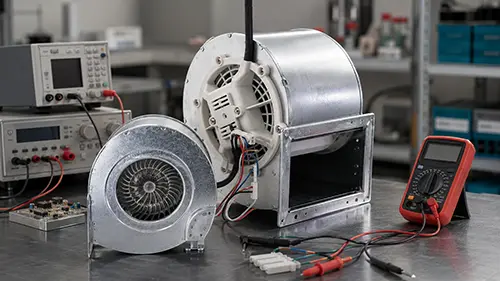
This RPM stability is what determines real-world CFM. A motor that loses RPM as static pressure rises will deliver far less airflow than its free-air rating suggests. The K30’s published maximum airflow of 4,500 CFM should be read as a ceiling achieved under favorable housing and pressure conditions, not a guaranteed output across every installation.
Warning: Never assume a motor holds its free-air CFM rating in an installed system. Always request the fan curve — CFM plotted against static pressure — before finalizing a duct design.
Engineering Design Behind the K30’s Power Rating
The K30’s power rating is a direct result of its internal construction. The stator uses fully copper windings, which minimizes electrical resistance and reduces thermal waste compared with lower-grade winding materials. The rotor core is built from silicon steel sheets, which reduces eddy current losses and improves magnetic flux density, allowing the motor to sustain torque without a proportional increase in current draw.
Heat management is built into the housing itself. The exterior casing on metal-body variants is a finned aluminum alloy design that functions as an active heat sink, drawing heat away from the windings through the intake airstream. This is paired with an electrophoretic-coated finish that resists corrosion from grease, cleaning chemicals, and steam — all common in kitchen exhaust environments.
Acoustic performance is also engineered rather than incidental. ElectroNasa dynamically balances the K30 rotor assembly to the ISO 1940-1 balancing standard, which reduces the micro-vibrations that cause structural resonance and excess noise. This balancing is what allows the motor to sustain 58–65 dB at full velocity despite its airflow output.
Comparing the K30 Series Motor Variants
The K30 series is available in three physical configurations, each built on the same 30mm stator platform but suited to different chassis and application requirements.
| Attribute | K30 Metal (1114/1118) | K30 Plastic Standard (1112/1116) | K30 Plastic Forward-Blade (1112/1116) |
| Housing Material | Metal, heat-resistant | Flame-retardant engineering plastic | Flame-retardant engineering plastic |
| Impeller | Standard | Standard | Forward-curved blade |
| Air Outlet Diameter | 120 mm | 100 mm | 100 mm |
| Speed Settings | 4-speed | 4-speed | 4-speed |
| Stator Thickness | 30 mm | 30 mm | 30 mm |
| Warranty | 30-month unconditional + 5-year full | 30-month unconditional + 5-year full | [Information Required] — warranty terms not published for this variant |
| Best Suited For | Applications requiring maximum mechanical and heat resistance | Standard OEM integration on existing production lines | Domestic hoods requiring a lightweight, sustained-performance blower |
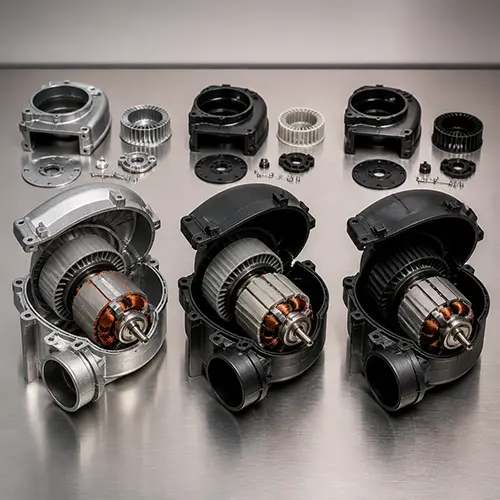
The metal-housing variant’s larger 120mm air outlet supports higher-volume air discharge with reduced outlet-side noise, making it the preferred choice where duct diameter allows. The plastic variants use the industry-standard 100mm outlet, simplifying integration into existing hood chassis without modification.
Applications for K30 Power Ratings in Range Hood Design
Range hood designers use the K30’s power and airflow data to size the motor against the kitchen’s exhaust requirement, typically calculated from cooking equipment heat load or applicable ventilation code. For commercial kitchen applications, designers can also refer to ASHRAE guidance on kitchen ventilation and exhaust system design when establishing the airflow requirements of a hood system.
Beyond built-in range hoods, the same power and thermal characteristics extend the K30 to other extraction applications: welding and fabrication fume extraction, chemical storage ventilation, and industrial paint booth exhaust, all of which share the requirement for sustained airflow against restrictive ducting.
Commercial kitchens add a duty-cycle dimension. The K30’s Class F insulation and IP54/IP55 housing options are designed for demanding exhaust applications, while the permissible ambient operating temperature depends on the specific motor configuration and should be confirmed from the manufacturer’s datasheet. For continuous commercial duty, the selected configuration should be verified against the actual operating temperature, duty cycle, and installation conditions.
Residential installations typically run intermittently, so the power margin built into the K30’s rating provides headroom rather than a strict operating requirement.
How to Select the Right K30 Power Rating
Selecting the correct K30 configuration starts with the required airflow at the installation’s actual static pressure, not with the highest available power figure. Use the following checklist when evaluating a K30 motor against a specific hood design.
Once the required airflow, static pressure, voltage, and housing configuration have been established, the next step is to compare the available K30 configurations and select the model that best matches the hood design. Explore the K30 series exhaust fan motors to review available configurations and identify the appropriate motor for your application.
- Confirm required CFM based on cooking equipment heat load or applicable ventilation code.
- Calculate the system’s static pressure, including duct length, bends, and filter resistance.
- Confirm the 1400 RPM rating is sufficient at your calculated static pressure, or request a fan curve for other speed settings.
- Match voltage (110V/220V/240V) and phase configuration to the installation’s electrical supply.
- Select the metal housing for maximum thermal and mechanical resistance, or the plastic housing for standard-line integration.
- Confirm the 100mm or 120mm air outlet diameter matches the existing duct connection.
- Verify noise level (58–65 dB) against the space’s acoustic requirements.
- Confirm warranty terms directly with ElectroNasa for the selected variant.

Best Practice: Specify by system requirement — airflow at your calculated static pressure — and let that determine the power rating, rather than choosing the highest-wattage option by default.
Common Mistakes When Specifying K30 Motor Power
Specifiers frequently compare the K30’s free-air CFM rating directly against a competing motor’s rating without confirming both were tested at the same static pressure. A motor tested at lower resistance will show inflated airflow figures, making the comparison misleading regardless of the wattage listed.
Another common error is treating the 350W–750W range as a single fixed number. Because the K30’s power draw depends on voltage configuration and housing, requesting a datasheet for the specific SKU and voltage combination under consideration avoids specifying a motor that underperforms the intended application.
A third mistake is ignoring duty cycle when placing an order. A configuration suited to intermittent residential use may not be the correct choice for a kitchen running exhaust continuously through long service hours, even though both operate within the same 350W–750W family.
Best Practices for Verifying K30 Power Ratings
Request the manufacturer’s full technical datasheet for the specific SKU and voltage configuration, not just the summary range published for the series. ElectroNasa’s engineering team provides this documentation directly to OEM buyers and can confirm current, RPM, and airflow figures for a given static pressure.
Confirm the balancing and quality standards referenced for the unit under consideration. ElectroNasa states that K30 rotors are balanced to the ISO 1940-1 standard, and the K30 series carries CE marking, ISO 9001:2015 quality management certification, and Iranian National Standard conformity. External references such as ASHRAE and NEMA provide broader context for evaluating ventilation motor specifications against recognized industry practice.
Finally, validate the rating against actual installation conditions. A conversation with ElectroNasa’s engineering team, referencing the specific hood design, duct layout, and calculated static pressure, resolves sizing questions faster than comparing published ranges alone.
Frequently Asked Questions
What is the power range of the K30 motor? The K30 series ranges from 350W to 750W depending on voltage configuration and housing, with amperage draw between 3.2A and 5.5A at full load.
What voltage options does the K30 support? The K30 operates on 110V, 220V, or 240V supply at 50Hz or 60Hz, in both single-phase and three-phase configurations.
How much airflow does the K30 motor produce? Rated airflow ranges from 2,800 to 4,500 CFM depending on the housing configuration selected, measured under the manufacturer’s stated test conditions.
Does the K30 motor lose RPM under static pressure? The K30 is designed to hold its rated 1400 RPM up to 1.5 inches of water gauge of static pressure. Beyond that point, RPM and airflow should be confirmed against the manufacturer’s fan curve.
Is the K30 motor suitable for continuous commercial duty? Yes, the K30 can be specified for continuous commercial-duty applications, but suitability depends on the selected configuration and actual installation conditions. Class F insulation refers to the motor’s insulation thermal class and should not be interpreted as a 155°C ambient operating rating. For 24/7 applications, confirm the permissible ambient temperature, duty cycle, and other operating limits in the datasheet for the specific K30 configuration.
How loud is the K30 motor at full load? Published noise levels range from 58 to 65 dB at full velocity, achieved through dynamic rotor balancing to the ISO 1940-1 standard.
What is the difference between the metal and plastic K30 housings? The metal-housing variant (1114/1118) uses a 120mm air outlet and offers maximum thermal and mechanical resistance. The plastic variants (1112/1116) use the industry-standard 100mm outlet for direct integration into existing production lines.
What certifications does the K30 series carry? The K30 series is manufactured under CE marking, ISO 9001:2015 quality management certification, and Iranian National Standard conformity, according to the manufacturer.
Request K30 Technical Specifications
Confirming the exact power, RPM, and airflow figures for your specific hood design requires the datasheet for your chosen K30 voltage and housing configuration. Contact ElectroNasa’s engineering team to request current technical specifications and OEM customization options for your project.
Request Technical Specifications · Contact Engineering Team