How Airflow Performance Affects Kitchen Hood Motor Selection
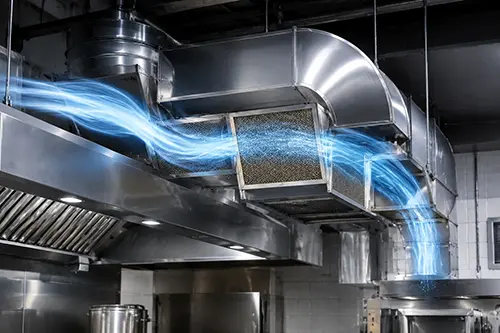
Hood motor airflow directly dictates the efficiency, safety, and acoustic performance of commercial and residential kitchen ventilation systems. Selecting the proper motor requires matching the volumetric airflow—measured in Cubic Feet per Minute (CFM)—against the physical resistance of the ductwork. If a motor is undersized, smoke and grease accumulate; if oversized, the system wastes energy and generates excessive noise. This guide explains the engineering mechanics behind airflow performance, the role of the centrifugal blower, and how to evaluate specifications to select the correct kitchen hood motor for OEM manufacturing applications.
What Defines Hood Motor Airflow Performance?
Airflow performance represents the volume of air a motor can move within a specific time frame under operational conditions. In kitchen ventilation, this is the primary metric for evaluating a motor’s capability.
The fundamental measurement of hood motor airflow is CFM. This metric defines how many cubic feet of air the system exhausts every sixty seconds. However, an isolated CFM rating is insufficient for engineering selection. True airflow performance is a dynamic calculation that must account for static pressure—the resistance created by filters, duct length, bends, and exterior wind loads. A motor rated for 1000 CFM in free air may only deliver 600 CFM when installed in a high-resistance system.
Therefore, defining performance requires mapping the motor’s capabilities across a complete pressure curve.
Technical Mechanics of a Centrifugal Blower
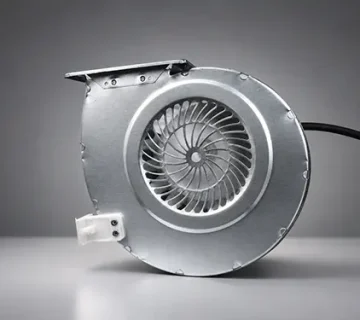
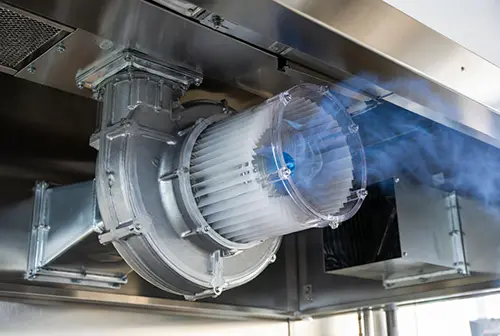
A centrifugal blower is the standard mechanism used in kitchen hood motors to generate airflow. Unlike axial fans that push air parallel to the shaft, centrifugal systems draw air into the center of an impeller and accelerate it outward at a 90-degree angle.
This 90-degree acceleration relies on centrifugal force, which builds pressure effectively. The impeller blades trap the incoming air, kinetic energy increases as the wheel spins, and the volute (the scroll-shaped housing) converts this kinetic energy into static pressure. Because commercial kitchens feature restrictive grease filters and complex duct runs, the high-pressure generation of a centrifugal blower is mandatory. Axial fans cannot overcome these physical restrictions.
Engineering Tip: The geometry of the impeller blades—forward-curved, backward-inclined, or radial—determines the exact airflow performance curve. Backward-inclined blades typically offer the highest efficiency and are less prone to overloading.
Engineering Insight: Overcoming System Resistance
To achieve optimal hood motor airflow, the motor must overcome system resistance. Every component in the ventilation path restricts air movement.
When selecting a motor, engineers must calculate the total static pressure of the installation environment. For example, replacing a straight 8-inch duct with a 6-inch duct containing two 90-degree elbows drastically increases resistance. If the centrifugal blower lacks the required torque to maintain RPM against this resistance, the CFM drops exponentially.
Selecting a reliable requires matching the motor’s performance curve to the calculated system curve. Where the two curves intersect is the actual operating point.
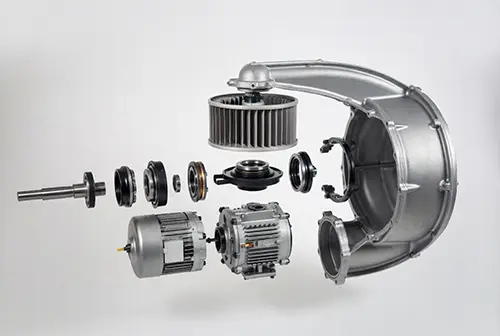
Comparison: Standard vs. High-Performance Centrifugal Blowers
Evaluating airflow performance requires comparing the motor’s capabilities under load. The following table outlines the operational differences between standard and high-performance blower designs.
| Feature | Standard Centrifugal Blower | High-Performance Centrifugal Blower |
| Airflow (CFM) | Up to 600 CFM | 600 – 1500+ CFM |
| Optimal Application | Residential / Light Commercial | Heavy Commercial / Industrial OEM |
| Static Pressure Tolerance | Low to Moderate | Extremely High |
| Energy Efficiency | Moderate | High (often utilizing EC motor technology) |
| Acoustic Profile | Increases under load | Optimized for low noise at high RPM |
Select the high-performance option when designing systems for heavy commercial use or complex duct architectures.
Selection Guidance for OEM Kitchen Hood Motors
Selecting the correct motor requires a systematic approach to ensure long-term reliability and compliance with [External Link: IEC Standards]. Follow these criteria when evaluating a supplier for OEM integration.
- Calculate Baseline CFM: Determine the required volume based on the cooking surface area and heat generation.
- Determine Static Pressure: Evaluate the maximum duct length and filter density.
- Analyze the Performance Curve: Request the manufacturer’s fan curve chart to verify the motor delivers the required CFM at the calculated pressure.
- Verify Component Quality: Ensure the bearings and [Cluster Link: Motor Efficiency] ratings meet the application’s thermal requirements.
- Confirm Certifications: Request documented testing data, ensuring no [Information Required] gaps exist in the safety profile.
Common Mistakes in Airflow Specification
Engineers and purchasing managers frequently encounter performance failures due to specification errors. Avoid these common mistakes to maintain consistent hood motor airflow:
- Ignoring the fan curve: Selecting a motor based solely on maximum free-air CFM.
- Undersizing the ductwork: Forcing high airflow through narrow ducts, creating severe acoustic issues.
- Neglecting voltage fluctuations: Failing to account for how inconsistent power supplies reduce operational RPM.
- Overlooking thermal protection: Specifying standard motors in high-heat commercial environments without thermal overload protection.
Warning: Never substitute an approved with a generic alternative without recalculating the system’s total static pressure.
Maintenance Best Practices for Airflow Consistency
Consistent airflow performance requires scheduled preventive maintenance. Neglecting these tasks leads to rotor imbalance, reduced CFM, and eventual motor failure.
- Inspection Frequency: Inspect the centrifugal blower housing and impeller blades every six months.
- Cleaning: Remove grease accumulation from the impeller. Even minor buildup alters the aerodynamic profile and reduces CFM.
- Lubrication: Verify bearing condition. If the motor utilizes sealed bearings, check for abnormal thermal output or vibration.
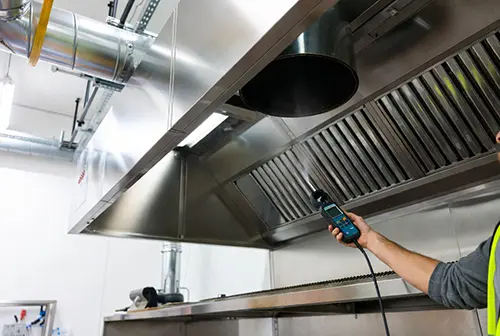
- Testing: Utilize an anemometer to verify that the airflow at the hood intake matches the specified design criteria.
Frequently Asked Questions (FAQ)
What is CFM in a kitchen hood motor? CFM stands for Cubic Feet per Minute. It is the standard measurement of volumetric airflow performance, indicating how much air the motor exhausts from the kitchen space in one minute.
How does static pressure affect hood motor airflow? Static pressure restricts airflow. As resistance from filters and ductwork increases, the motor must work harder to push air. If the static pressure exceeds the motor’s capability, the actual CFM will drop significantly.
Why are centrifugal blowers used instead of axial fans? A centrifugal blower generates much higher static pressure than an axial fan. This pressure is mandatory to push air through the dense grease filters and long duct runs typical in commercial kitchen ventilation.
Can I increase my hood motor airflow by installing a larger motor? Not always. Installing a motor with a higher CFM rating into existing undersized ductwork will sharply increase system resistance and noise, often resulting in diminished performance and motor overheating.
What happens if a hood motor is undersized? An undersized motor will fail to generate sufficient airflow to capture smoke, heat, and grease. This leads to poor indoor air quality, potential fire hazards, and accumulation of grease on kitchen surfaces.
How do I read a fan performance curve? A fan curve graphs CFM against static pressure. The vertical axis represents pressure, and the horizontal axis represents airflow. You must plot your system’s calculated resistance on this graph to find the true operating point of the motor.
Do higher CFM ratings mean a louder motor? Generally, moving more air creates more noise. However, premium motors utilize optimized blade geometry, sound-dampening enclosures, and EC technology to minimize acoustic output even at high CFM levels.
How frequently should a kitchen hood motor be cleaned to maintain airflow? In commercial environments, the centrifugal blower and surrounding housing should be inspected and cleaned every three to six months. Heavy grease buildup on the impeller blades disrupts aerodynamics and permanently degrades airflow performance.
[Image: turbo-motors-industrial-range.webp]