K30 Motor Airflow Performance: What Buyers Should Measure
For OEM appliance manufacturers, the marketing claims surrounding centrifugal blowers are notoriously misleading. A supplier may advertise a motor at “1000 CFM,” yet when installed in your newly designed range hood, it barely extracts 400 CFM.
This catastrophic drop in performance is not necessarily a defect; it is a failure to properly calculate fluid dynamics. To evaluate true K30 airflow performance, procurement managers and R&D engineers must look beyond simplified marketing metrics and demand rigorous aerodynamic testing data.
This technical guide explains exactly what metrics OEM buyers should measure, how duct resistance alters performance, and how to read the aerodynamic performance curves of the Electro NASA K30 series to ensure flawless appliance extraction.
The “Free Air” Trap in Appliance Procurement
The most common mistake in OEM procurement is purchasing based on Free Air Delivery.
Free air CFM measures the volume of air a motor moves when it is sitting on a test bench with absolutely zero restrictions (no filters, no hood canopy, no exhaust ducting).
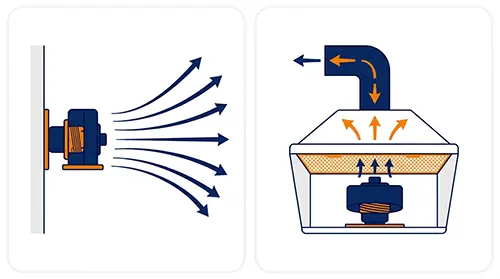
In reality, a range hood motor never operates in “free air.” Once installed, the motor must pull air through dense stainless-steel baffle filters and push it through winding, narrow ductwork. This resistance is known as Static Pressure; you can estimate your own duct losses with Engineering Toolbox’s air duct friction loss calculator. If a motor lacks the aerodynamic torque to overcome this pressure,, its volumetric airflow plummets. OEM buyers must evaluate a motor based on its Operational CFM—the actual airflow it can sustain while fighting realistic static pressure.
3 Essential Metrics for Evaluating K30 Airflow Performance
When validating an Electro NASA K30 motor for your appliance line, your R&D team must measure three interdependent metrics.
1. Volumetric Airflow (CFM or m³/h)
This is the raw volume of air the motor displaces. While crucial, it is only part of the equation. High volumetric airflow is relatively easy to achieve with cheap forward-curved impellers—provided there is zero resistance.
2. Static Pressure Resistance (Pa or in.WG)
Measured in Pascals (Pa) or Inches of Water Gauge (in.WG), static pressure is the physical resistance the air encounters inside the appliance and ductwork. The K30 series is specifically engineered to generate high static pressure, meaning it possesses the mechanical “pushing power” necessary to force air through severe restrictions without stalling.
3. Operating Point (The System Curve Intersection)
Every appliance has a unique “System Curve” (the exact amount of resistance created by your specific hood chassis and filters). The Operating Point is the exact location on a graph where the K30’s performance curve intersects with your appliance’s system curve. This intersection reveals the exact, true CFM your appliance will deliver to the end consumer.
How the K30 Backward-Curved Architecture Defeats Pressure
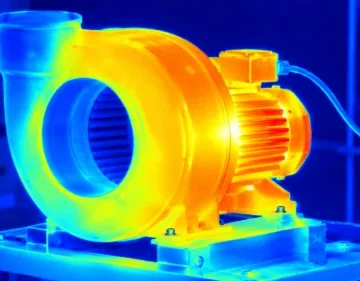
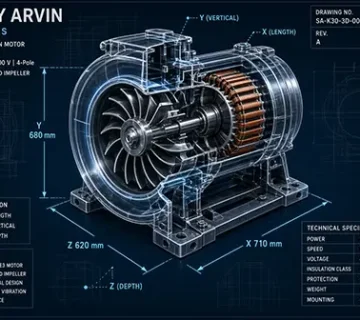
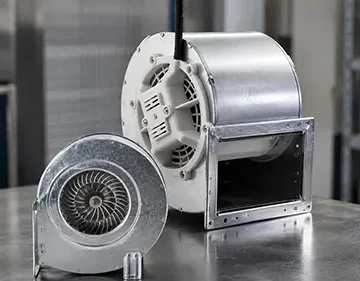
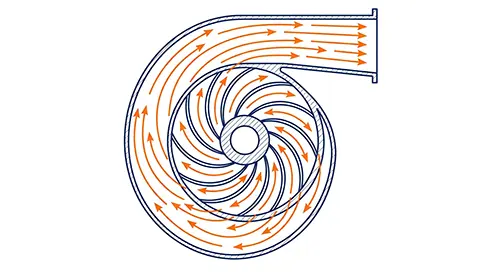
To maintain high volumetric airflow under severe static pressure, the K30 1111/1115 and 1113/1117 models utilize a heavy-duty backward-curved impeller.
Unlike standard “squirrel cage” blowers, the blades on the K30 curve away from the direction of rotation. This geometry creates a highly efficient fluid dynamic compression zone within the scroll housing. As resistance (static pressure) builds up in the ductwork, the backward-curved impeller relies on its high torque and kinetic energy to smoothly slice through the air column.
This results in a non-overloading aerodynamic profile. Even if the ductwork is highly restrictive, the K30 will sustain a high percentage of its CFM without the motor experiencing electrical slip or thermal overload.
Reading K30 Aerodynamic Performance Curves
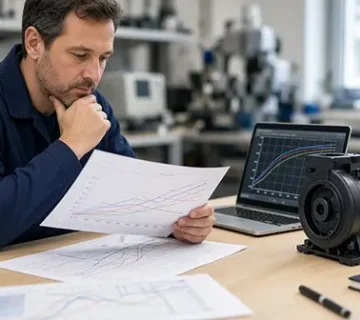
When evaluating suppliers, OEM procurement teams must request an Aerodynamic Performance Curve. This graph plots the motor’s performance across all levels of resistance.
- The Y-Axis (Static Pressure): Represents the resistance in the duct.
- The X-Axis (Airflow/CFM): Represents the volume of air moved.
When reading a K30 curve, you will notice that the line does not drop vertically as pressure increases (a common flaw in cheap motors). Instead, it arcs smoothly, demonstrating that the motor continues to deliver robust volumetric airflow even when the Static Pressure approaches 300 Pa or higher.
OEM Procurement Checklist: Validating Airflow Data
To protect your appliance’s reputation and avoid post-sale performance complaints, procurement managers should follow this validation checklist:
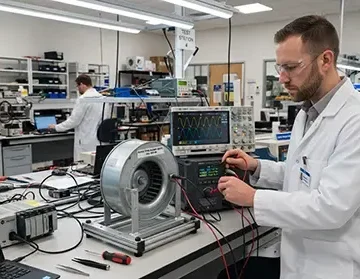
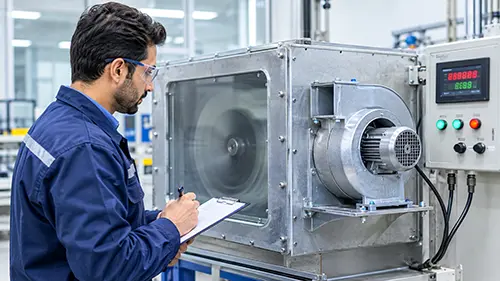
- Demand Chamber Data, Not Bench Data: Ensure the CFM rating provided by the supplier was measured in a sealed aerodynamic testing chamber (following AMCA standards), not simply calculated by placing an anemometer in front of an open motor.
- Verify Voltages During Testing: Airflow drops if voltage drops. Verify that the performance curve provided was tested at the exact voltage your target market utilizes (e.g., exactly 220V or exactly 240V).
- Cross-Reference Acoustic Data: High CFM is useless if the motor rattles. Demand that the aerodynamic curve is accompanied by a decibel (dB) rating, proving that the factory utilized precision dynamic balancing to maintain quiet operation at peak airflow.
Frequently Asked Questions
Why does adding a charcoal filter to my hood reduce the K30’s CFM? Charcoal (carbon) filters used in ductless recirculating hoods are incredibly dense. They drastically increase the Static Pressure (the resistance) in the system. While the K30’s backward-curved impeller is highly effective at pushing through this restriction, the laws of fluid dynamics dictate that increased pressure will result in a measured reduction in overall CFM.
Is a higher CFM rating always better for a range hood? No. If you install a massively overpowered motor in a range hood with a very narrow exhaust duct (e.g., 4-inch ducting), the motor will attempt to force more air than the pipe can handle. This creates severe air turbulence, leading to extreme aerodynamic noise (whooshing) and potential motor stalling. The motor must be sized to the duct architecture.
How does altitude affect K30 airflow performance? Air density decreases at higher altitudes (e.g., in mountainous regions). Because the air is thinner, the same fan at the same speed moves a similar volume of air (CFM) but develops lower static pressure and draws less power, since both scale with air density.
Can we increase the K30’s CFM by increasing the RPM? Yes, volumetric airflow scales directly with RPM. However, Electro NASA strictly calibrates the K30 to operate at a specific maximum RPM to prevent acoustic resonance and bearing failure. Altering the PCB to force the motor beyond its rated RPM can cause overheating and mechanical wear, so confirm any modification with Electro NASA engineers first.

Procure motors backed by verified fluid dynamic data. Request an OEM Quotation & Production Lead Time for the aerodynamically superior K30 series.
Unsure if your appliance ducting will restrict airflow? Consult with Electro NASA Technical Sales Engineers to calculate your exact system static pressure.