K30 Motor Dimensions and Mounting Hole Requirements
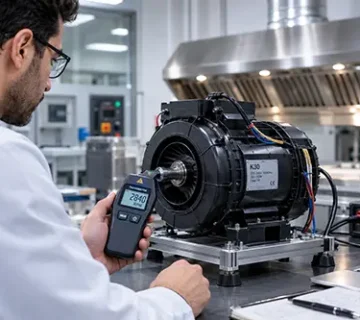
For industrial designers and mechanical engineers developing OEM range hoods, electrical specifications are only half the battle. A motor with exceptional torque and acoustic performance is useless if its physical footprint clashes with the appliance’s internal architecture. Accurately plotting the K30 motor mounting dimensions isthe fundamental first step in translating a conceptual appliance design into a manufacturable product.
Failure to respect spatial tolerances or misalignment of mounting holes leads to disastrous consequences on the assembly line: forced fitments, stripped screws, and metallic resonance caused by the motor housing rubbing against the appliance canopy.
This technical guide provides R&D teams with a comprehensive overview of the K30 series’ mechanical footprint, detailing the requirements for hole alignment, vibration isolation, and how to leverage Electro NASA’s capacitor-less architecture to build sleeker, more compact kitchen appliances.
The Critical Role of Mechanical Integration in Range Hoods
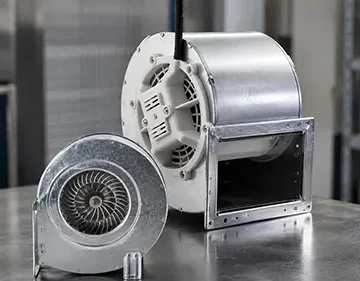
Centrifugal blowers, by their nature, require specific geometric housings (volutes) to generate aerodynamic pressure. This scroll shape dictates the overall K30 motor dimensions.
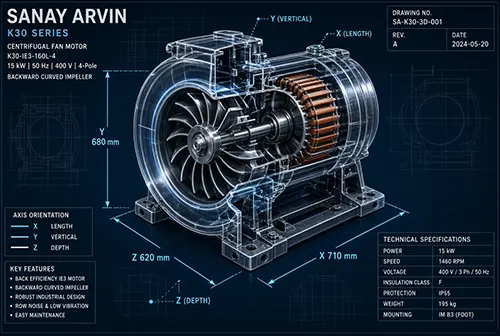
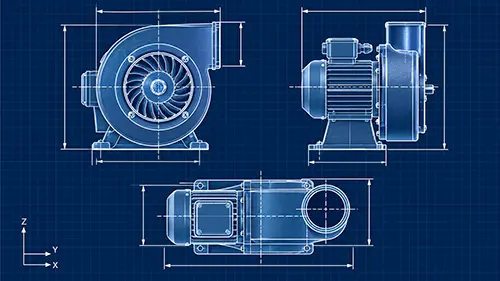
When designing the metal stamping dies for your appliance chassis, your mechanical engineering team must account for the motor’s exact X, Y, and Z axes, the location of the exhaust outlet, and the precise coordinates of the mounting brackets. A discrepancy of even 2 millimeters between your stamped chassis holes and the motor’s bracket can halt an entire OEM production run.
The 3 Rules of Centrifugal Motor Mounting
To ensure seamless integration and prevent post-sale warranty claims related to noise, mechanical engineers must adhere to three foundational mounting rules.
1. Ensuring Volumetric Clearance
The motor must never touch the internal walls of the range hood canopy (other than at the designated mounting points). You must calculate a strict volumetric clearance zone around the entire volute. If a K30 motor housing physically contacts the thin stainless-steel shell of the appliance, it creates a mechanical bridge, transferring normal operational humming into loud, amplifying acoustic resonance.
2. Strict Hole Alignment and Tolerances
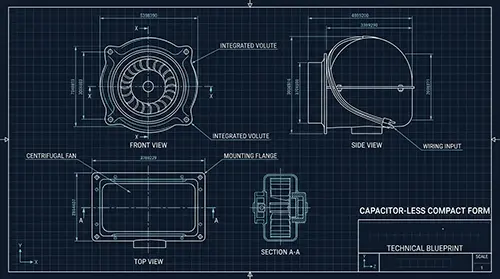
The K30 series features standardized mounting brackets designed for heavy-duty suspension. When importing Electro NASA CAD files, ensure your chassis design aligns perfectly with these coordinates. Forcing a misaligned screw applies unequal torsional stress to the motor’s chassis. Over time, this stress can warp the volute, slightly shifting the internal backward-curved centrifugal impeller and destroying the motor’s precision dynamic balancing.
3. Mandatory Vibration Isolation
You must never bolt a centrifugal motor directly metal-to-metal against the appliance chassis. Mechanical engineers must design the mounting points to accommodate vibration isolation grommets (typically high-density rubber or silicone washers). These grommets act as shock absorbers, deadening kinetic energy and ensuring the appliance operates silently, even when the K30 is running at maximum RPM.
Space Optimization: The Capacitor-Less Advantage
One of the most significant mechanical challenges in designing modern, minimalist range hoods (such as concealed cabinet inserts or slim telescopic models) is finding space for internal components.
The K30 series addresses this directly through its capacitor-less architecture.
In traditional AC motor configurations, a bulky cylindrical run capacitor is bolted directly to the exterior of the motor volute. This creates an awkward protrusion that significantly increases the required volumetric space. Electro NASA engineers the K30 to operate with an external capacitor, allowing OEM designers to move this component entirely off the motor and integrate it directly onto the appliance’s main printed circuit board (PCB) housing.
This simple architectural shift dramatically reduces the K30’s physical footprint, granting industrial designers the freedom to create slimmer, more aesthetically pleasing range hoods without sacrificing heavy-duty extraction power.
K30 Series Material Profiles and Mounting Considerations
The physical material of the K30 motor dictates its overall weight and specific mounting requirements. Electro NASA offers the K30 in two distinct structural architectures:
Weld-Less Galvanized Steel Housings
Models like the K30 1113 and 1117 utilize galvanized steel housings assembled using an interlocking, weld-less technique. This construction is highly resistant to galvanic corrosion and extreme thermal loads (commercial applications). However, because steel is heavier than plastic, OEM engineers must ensure the appliance’s stamped mounting brackets are structurally reinforced to support the additional mass, preventing the metal canopy from sagging over time.
Needle-Flame Plastic Volutes
Models like the K30 1111 and compact 3111 utilize industrial-grade, needle-flame standard fire-retardant plastics. These units are significantly lighter, making them ideal for telescopic or lightweight concealed hoods. The reduced mass lowers the start-up inertia and decreases the structural stress applied to the appliance’s mounting points, allowing for thinner gauge steel in your chassis design.
How to Utilize Electro NASA Dimensional CAD Files
To eliminate trial and error, Electro NASA provides exact Dimensional CAD Files (typically in STEP or IGES formats) to qualified OEM partners.
- Import the Volute: Drop the 3D motor model directly into your appliance assembly in SolidWorks or AutoCAD.
- Verify Clearances: Run an interference detection check to ensure the K30 housing maintains the required volumetric clearance from all internal baffles and wiring harnesses.
- Export Stamping Coordinates: Extract the exact X/Y coordinates of the K30 mounting holes to program your factory’s CNC punching or metal stamping machinery, guaranteeing 100% alignment on the assembly line.
Frequently Asked Questions
Do the mounting dimensions change if I request a different motor speed mapping? No. The physical volute, mounting brackets, and overall dimensions remain entirely identical regardless of whether you order a standard 3-speed configuration or a custom speed PCB mapping. This allows you to use a single appliance chassis design across multiple product tiers.
What size vibration isolation grommets are required for the K30 series? While the exact durometer (hardness) of the rubber depends on the weight of your specific appliance chassis, Electro NASA’s engineering team can provide specific recommendations for grommet thickness and diameter based on the mechanical load of the galvanized or plastic K30 models.
Can the exhaust outlet diameter be customized? The physical scroll housing and exhaust outlet diameter (e.g., standard 120mm or 150mm connections) are generally fixed to ensure optimal aerodynamic static pressure. However, for extreme high-volume OEM orders, minor injection molding tooling adjustments can be discussed with our R&D department.
Is the K30 motor suitable for vertical and horizontal mounting? Yes. The self-lubricating ball bearings used in the K30 series are designed to handle both radial and axial loads, meaning the motor will perform reliably and quietly regardless of whether the appliance architecture requires it to be mounted horizontally or vertically.
Ready to move from digital design to physical prototyping? Request an OEM Quotation & Production Lead Time for a custom K30 sample.
Struggling to fit a heavy-duty motor into a slim cabinet design? Consult with Electro NASA Technical Sales Engineers to explore our compact, capacitor-less architectures.